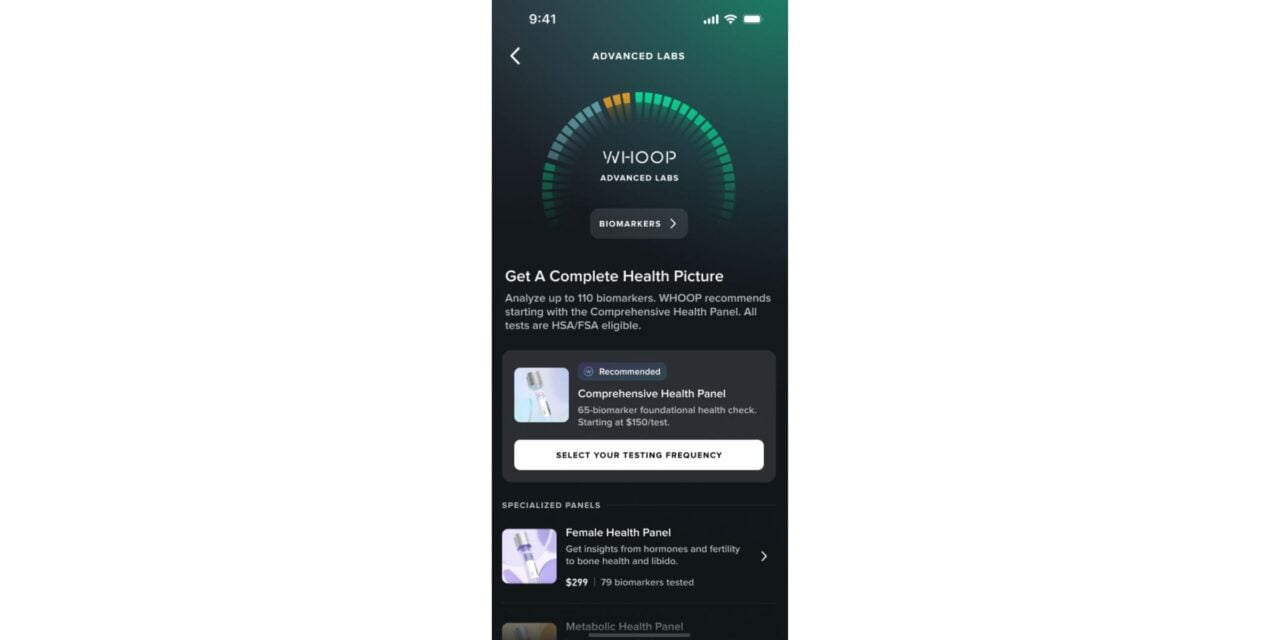
The new panel includes 11 female-specific biomarkers covering hormonal transitions, thyroid function, and nutrient levels.
WHOOP has announced the upcoming launch of its Women’s Health Specialized Blood Biomarker Panel, an expansion of its existing Advanced Labs offering that adds 11 clinically backed, female-specific blood biomarkers to its testing lineup. The panel is set to launch in April and will be available exclusively in the US at launch.
Building on the WHOOP Advanced Labs Baseline Panel introduced last year, the new panel is designed to provide deeper insight into areas that are frequently under-measured or misinterpreted in traditional women’s health testing, according to the company. Biomarkers included in the panel are: Anti-Müllerian Hormone (AMH), Progesterone, Prolactin, Thyroid Peroxidase Antibodies (TPOAb), Free T4, Free T3, Leptin, Vitamin B12 (Cobalamin), Folate, Magnesium, and Phosphate (as Phosphorus). These markers target cycle regulation and hormonal transitions, including perimenopause, thyroid function, nutrient sufficiency, and bone-metabolic resilience.
Members will be able to purchase the panel through the WHOOP app.
“Unlike solutions that focus on isolated conditions or single life stages, WHOOP delivers a connected health experience informed by one of the world’s largest datasets on women’s physiology,” says Alex Vannoni, head of healthcare product at WHOOP, in a release. “We’re not just helping women track their cycles. We’re helping them understand how their physiology evolves over time — and giving them tools to act on it.”
Integrating Lab Data With Wearable Metrics
A key feature of the new panel is its integration with WHOOP’s continuous wearable data and cycle tracking. When a member completes a blood draw, WHOOP automatically applies reference ranges aligned to where the member is in their menstrual cycle, categorizing results as “optimal,” “sufficient,” or “out of range,” according to the company. This approach is intended to ensure that biomarker results are interpreted in the context of a member’s individual physiology rather than relying on static population-level reference ranges.
By layering lab data on top of continuous wearable metrics and artificial intelligence modeling, WHOOP says members can see how biomarkers correlate with recovery trends, strain tolerance, sleep efficiency, and stress patterns over time.
“What makes this powerful isn’t any single data point—it’s how the system comes together,” says Emily Capodillupo, senior vice president of research, algorithms, and data at WHOOP, in a release. “Women don’t experience their physiology in silos. Hormones influence sleep, sleep affects recovery, and recovery shapes training response. By modeling these interactions over time—across continuous biometrics, lab data, and behavior—we can deliver guidance that reflects the full system, not just a snapshot.”
Additional Features and White Paper
Alongside the panel launch, WHOOP announced a Hormonal Symptom Insights and Predictions update to its existing Menstrual Cycle Insights and Pregnancy Insights offering. The update gives menstruating members access to a personalized cycle model that adapts over time based on their physiological data and historical patterns, allowing them to anticipate potential symptoms rather than simply recording them, according to the company.
WHOOP also published a Menstrual Cycle White Paper outlining the research, methodology, and validation behind its cycle modeling approach. According to the company, the white paper details how continuous physiological monitoring improves prediction accuracy over time, how the system accounts for variable cycles, perimenopause, and hormonal birth control, and how prediction windows dynamically adjust based on variability.
The company noted that women represent a growing share of new WHOOP members, with 150% year-over-year growth, and that women engage with WHOOP’s artificial intelligence features approximately 30% more than male members, according to a release.
Photo caption: WHOOP health panels app screen
Photo credit: WHOOP