Studies demonstrate spatial transcriptomics, 5-base sequencing, and proteomics applications in oncology diagnostics and therapeutic development.
Illumina Inc announced new customer research breakthroughs in oncology powered by the company’s spatial transcriptomics, 5-base sequencing, and proteomics technologies. The findings were presented at the Advances in Genome Biology and Technology annual meeting in Orlando earlier this year.
The combined portfolio delivers insights for precision diagnostics, targeted therapeutics development, and understanding of tumor microenvironments through Illumina Connected Multiomics for multimodal data analysis.
“Unlocking the human genome has changed the face of cancer care and opened up demand for the next wave of biological insights,” says Jacob Thaysen, chief executive officer at Illumina, in a release. “Researchers are rapidly adopting multiomics and informatics technologies that expand our understanding of biology at scale.”
Spatial Technology Maps Complex Lymphatic System
Ioannis Vlachos, director of the Spatial Technologies Unit within Beth Israel Deaconess Medical Center, used Illumina Spatial Technology to investigate human lymph nodes and lymphatic channels. The research aims to improve cancer diagnosis and prognosis by understanding how cancer metastasizes through the lymphatic system.
“Our research as an NIH HuBMAP Tissue Mapping Center aims to shed light on the complex function of lymphatic vessels, which are exceptionally challenging samples due to their low adhesion, surrounding adipose tissue, and small size,” says Vlachos, in a release. “Illumina Spatial Technology generated high-quality data from samples ranging from very small to quite sizable, producing the first ever whole transcriptome spatial datasets for human lymphatic collector vessels.”
The technology’s large capture area and serial sections helped researchers resolve single-cell-thick layers and reconstruct three-dimensional representations of tissue organization with whole transcriptome capture at 1-micrometer resolution.
In a separate study conducted by Illumina researchers, the spatial technology mapped breast cancer progression across precancerous to high-grade ductal carcinomas. Whole-transcriptome profiling revealed tumor microenvironment details, including identification of cancer-associated fibroblasts. Researchers found more than 2,000 unique transcripts in each cell.
5-Base Solution Adds Epigenetic Context
Researchers from Broad Clinical Labs explored Illumina’s 5-base solution for pediatric kidney cancer clinical research. This cancer type typically requires invasive surgical procedures for diagnosis, monitoring, and treatment.
The 5-base solution enabled simultaneous genomic and methylation profiling to identify cases missed by conventional approaches. Whole genomes from renal cancer patients tested in methylation-based classifiers predicted the presence of rhabdoid tumors missed by genomics-only methods.
“Combining these molecular signals in a single, scalable process can help us develop non-invasive diagnostics for cancers,” says Carrie Cibulskis, director of cancer genomics at Broad Clinical Labs, in a release. “We’re working toward a minimally invasive methylation-aware assay for cancer diagnosis and treatment selection.”
Multiomics Approach Targets Ovarian Cancer
Nearly 80% of ovarian cancers are diagnosed at advanced stages, where survival drops to about 30%. When caught early, survival exceeds 90%.
Bodour Salhia, a professor of cancer biology at the University of Southern California’s Keck School of Medicine, applied Illumina’s 5-base solution, Illumina Protein Prep, and Illumina Spatial Technology to adnexal masses. The method enabled differentiation between cancerous and benign tumor types using cell-free DNA.
Results included the first reported spatial analyses of adnexal masses and revealed localized tumor biology not previously reported.
“These findings create a multiomic framework for ovarian cancer research and lay the groundwork for an effective liquid biopsy in particularly challenging ovarian cancers with the potential to transform diagnostic practices and outcomes,” says Salhia, in a release. “Layering the omics gave us a winning combination, providing more context for earlier cancer identification.”
The methylation signals separated malignant and benign samples better than traditional approaches. Illumina Protein Prep allowed researchers to identify novel gene sets, proteins, and pathways in ovarian cancer. The layered approach through Illumina Connected Multiomics resolved a false positive case.
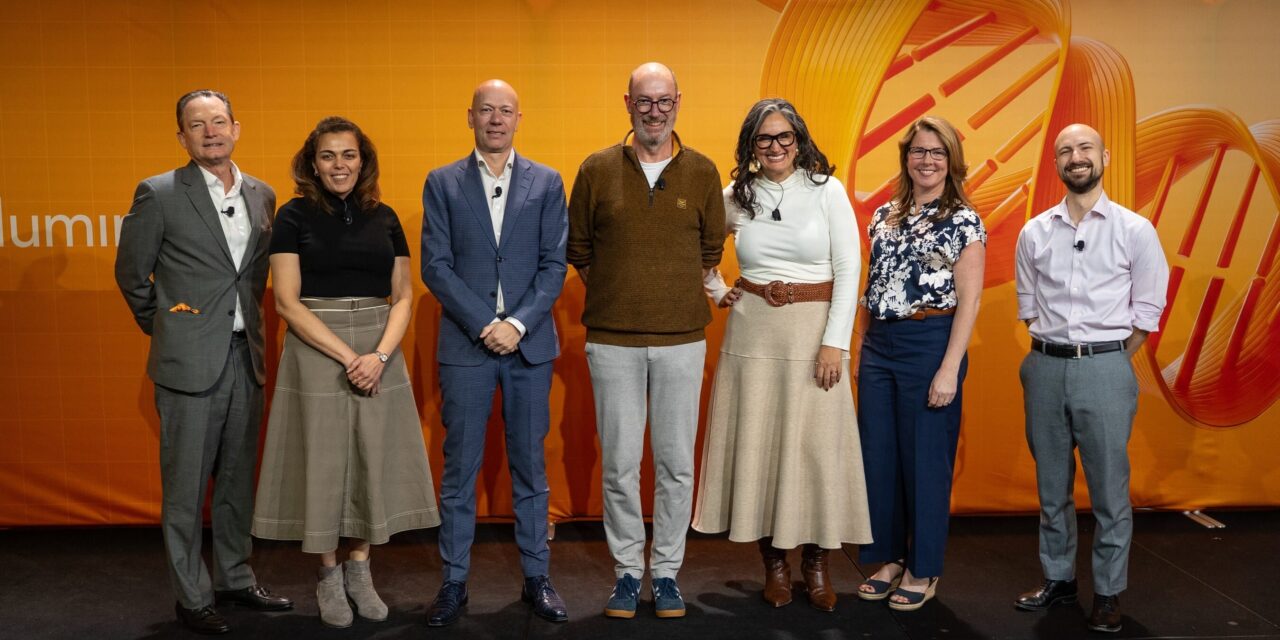
Photo caption: Left to right: Steve Barnard, PhD, Bodour Salhia, PhD, Jacob Thaysen, PhD, Marcel R. Nelen, PhD, Cande Rogert, PhD, Carrie Cibulskis, Sami Farhi, PhD
Photo credit: Illumina