
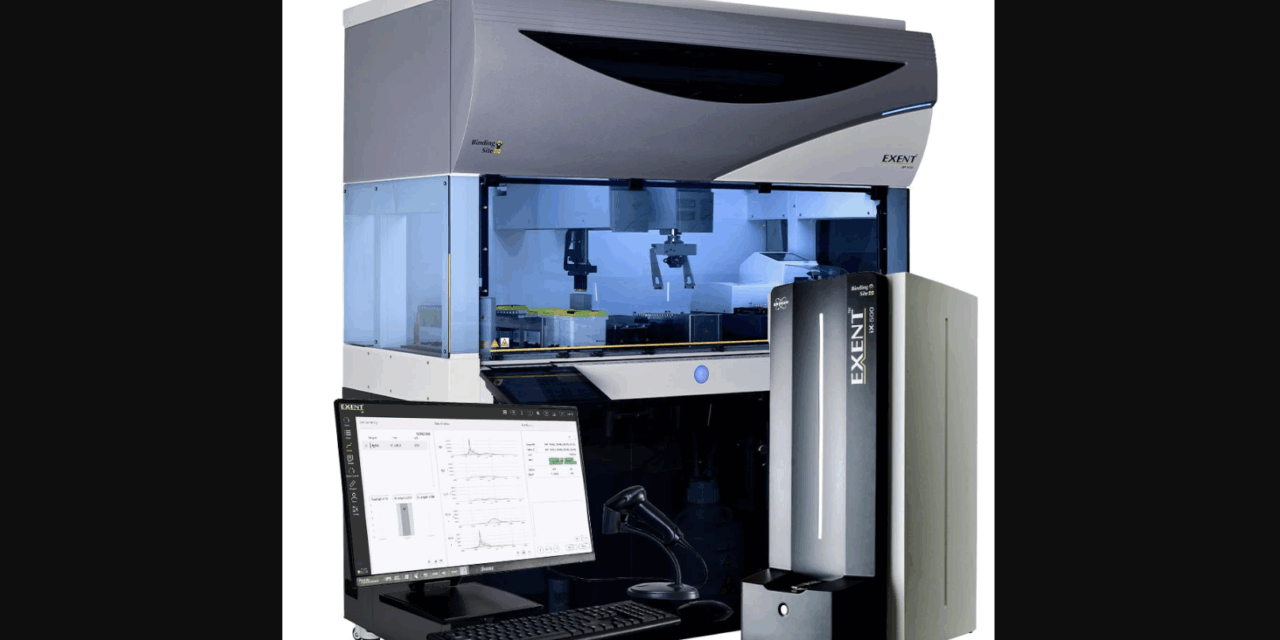
Thermo Fisher Scientific’s EXENT system, previously cleared to aid diagnosis, can now help labs track disease status and treatment response.
The US Food and Drug Administration (FDA) has cleared an expanded intended use for Thermo Fisher Scientific’s EXENT Analyser with the EXENT Immunoglobulin Isotypes (GAM) Assay. Clinical laboratories can now use the mass spectrometry-based system to aid in monitoring disease status and treatment response in patients with multiple myeloma and Waldenström’s macroglobulinemia.
The clearance builds on the system’s earlier FDA clearance to aid in diagnosis. Labs already using the EXENT system for diagnostic testing can extend the same workflow to ongoing patient monitoring, according to the company.
The system helps clinicians detect and track monoclonal proteins over time, including at low concentrations, and distinguish disease-related proteins from certain known therapeutic antibodies.
“This expanded clearance brings the precision of mass spectrometry beyond diagnosis and into ongoing monitoring, giving clinicians greater insight into disease status and treatment response,” says Stephen Harding, vice president and general manager of protein diagnostics at Thermo Fisher Scientific, in a release. “It reflects our commitment to bringing innovative diagnostics into clinical practice to help physicians make more informed decisions and give patients greater confidence in their care.”
The Clinical Need for Sensitive Monitoring
Multiple myeloma and Waldenström’s macroglobulinemia are both monoclonal gammopathies that require frequent, sensitive monitoring of monoclonal protein (M-protein) levels to assess disease status and treatment response and to detect potential relapse. Patients are typically monitored for M-protein levels throughout their lifetime following diagnosis. The National Cancer Institute estimates about 36,000 new cases of multiple myeloma occurred in the US in 2026.
Conventional methods may present challenges when M-protein concentrations are low or when treatment-related antibodies interfere with interpretation. According to Thermo Fisher Scientific, the EXENT system uses mass spectrometry-based detection to identify and track M-proteins within its cleared intended use. The company says this also lets clinicians follow a patient’s disease as it evolves, including when the immune system is rebounding after therapy.
The system is designed for routine use in clinical laboratories, and it requires no prior mass spectrometry expertise. The company says the technology offers enhanced sensitivity, objectivity, and reproducibility.
Over the last three years, the EXENT system has been used to test thousands of patients in 13 countries. With the expanded clearance, Thermo Fisher Scientific says laboratories and health care providers have a single platform that spans the patient journey from initial diagnosis through longitudinal monitoring.
Photo caption: EXENT system
Photo credit: Thermo Fisher Scientific