A proof-of-concept study shows that bacteria-metabolized molecules enriched with carbon-13 produce detectable exhaled CO2, enabling rapid infection identification with inexpensive infrared scanners.
A simple breath test may soon offer clinicians a faster, more accessible way to confirm bacterial infections, potentially reducing unnecessary antibiotic prescriptions.
A new proof-of-concept study led by researchers at St. Jude Children’s Research Hospital and the University of California, San Francisco (UCSF), published in ACS Central Science, demonstrates that molecules metabolized exclusively by infecting bacteria—not by the body’s natural gut microbiome—can be used to rapidly distinguish bacterial infection from viral infection or noninfectious inflammation.
The approach centers on mannitol, a molecule that is broken down only by bacteria. Researchers enriched mannitol with carbon-13, a naturally occurring stable carbon isotope, rather than the more common carbon-12. When administered intravenously, the carbon-13-labeled mannitol is metabolized by infecting bacteria, producing a labeled carbon dioxide byproduct that is subsequently exhaled. That exhaled carbon dioxide is then measured using a nondispersive infrared spectroscopy tabletop instrument—an inexpensive, commercially available device—making the test well-suited for a wide range of clinical settings.
In preclinical testing, the breath test successfully detected signs of myositis, bacteremia, pneumonia, and osteomyelitis. Researchers tested the approach against pathogens commonly encountered in clinical environments, including Staphylococcus aureus, Streptococcus pneumoniae, and Escherichia coli, as well as Salmonella enterica, a pathogen that poses particular risks for immunocompromised patients such as those with sickle cell disease.
Addressing a Longstanding Diagnostic Gap
Traditional bacterial infection diagnosis relies on laboratory culture, a process that can take days to yield results. The breath test approach is designed to fill that gap, offering a rapid screening option at the point of care.
“When a patient presents with certain symptoms, doctors already have an idea of the likely pathogens,” says Kiel Neumann, PhD, co-corresponding author and researcher in the St. Jude Department of Radiology, in a release. “We hope that this test could be a quick screening tool to know whether it’s a bacterial infection or not.”
The test may be especially valuable in cases where infection and inflammation are difficult to differentiate clinically. Neumann specifically highlighted the challenge in patients with sickle cell disease, where vaso-occlusive crises—which are purely inflammatory—can present with symptoms indistinguishable from infection.
“A patient might complain of nonspecific symptoms, like pain and swelling, but it is likely a vaso-occlusive crisis — purely inflammatory,” says Neumann in a release. “It could be an infection, however, and because the risk of missing an infection is high, they get antibiotics anyway, even if unnecessary.”
Next Steps Toward Clinical Validation
The researchers note that the study represents a first step, and that significant additional work is needed before the test can be validated for clinical use in humans. Co-corresponding author David Wilson, UCSF, and first author Marina López-Álvarez, UCSF, contributed to the research alongside a multi-institutional team.
“We want to explore how we can use this technology to have an impact at ground level—patients checking into urgent care or an emergency room, for example,” says Neumann in a release. “There’s a lot of work to do in humans to establish a true protocol, but we are very enthusiastic about its potential.”
The study was supported by the National Institutes of Health, the Cystic Fibrosis Foundation, and the American Lebanese Syrian Associated Charities.
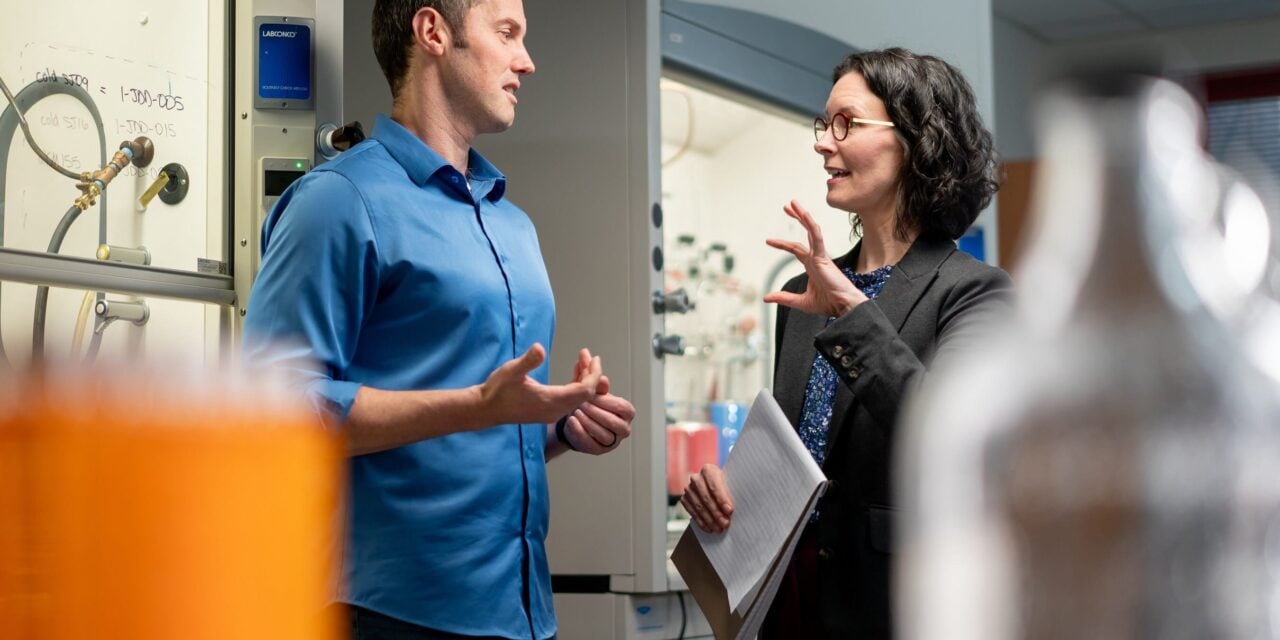
Photo caption: Published today in ACS Central Science, co-corresponding author Kiel Neumann, PhD, St. Jude Department of Radiology, and co-author Amanda Green, MD, St. Jude Department of Infectious Diseases, demonstrated how mannitol made with carbon-13 and a breath test can be used to immediately detect a bacterial infection.
Photo credit: St. Jude Children’s Research Hospital
Related Reading:
CRISPR Discovery Could Enable Single Test for COVID, Flu, RSV
Study Identifies Blood, Urine Tests That Could Reduce Spinal Taps in Newborns
DNAe Launches Early Access Program for NGS Diagnostic Platform
BD Expands BD Max System Menu with IVDR-Certified Viasure Assays
AI Diagnostic Applications Showcased at AMP 2025 Annual Meeting