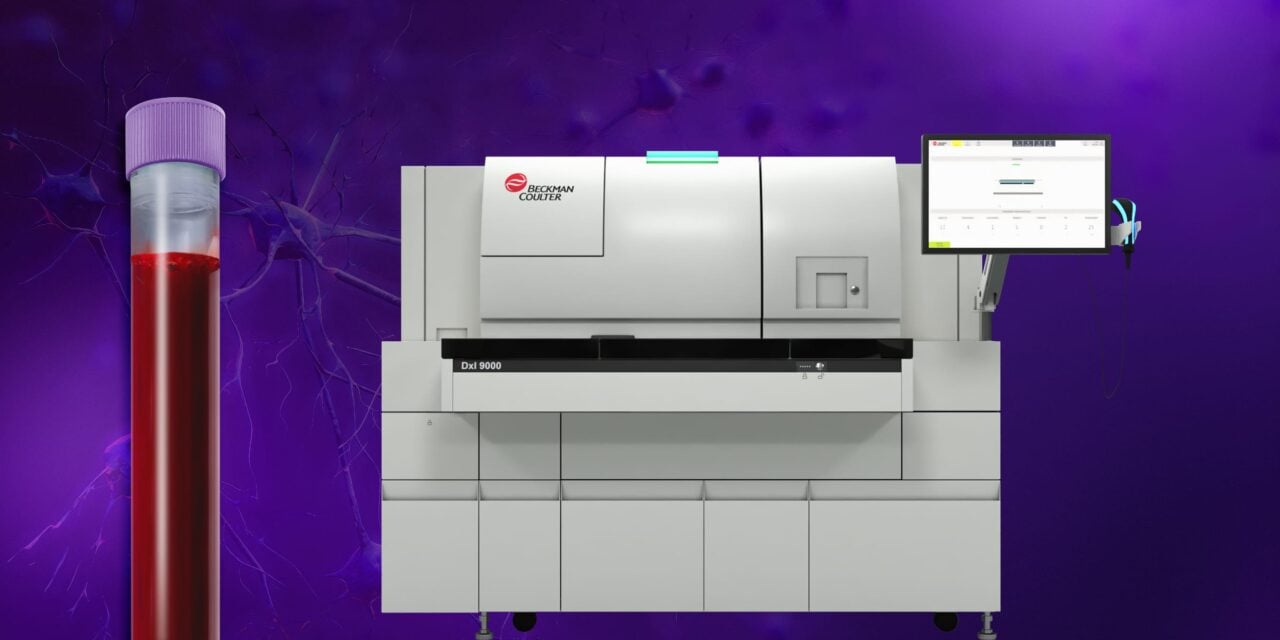
The p-Tau217 assay runs on the DxI 9000 Immunoassay Analyzer, enabling laboratories to incorporate blood-based Alzheimer’s biomarker testing into high-throughput workflows.
Beckman Coulter Diagnostics has received CE Mark under In Vitro Diagnostic Regulation for its Access p-Tau217 assay, a blood-based test designed to support the clinical evaluation of amyloid pathology in patients with signs and symptoms of cognitive decline.
The company will also introduce its Access BD-pTau217 Research Use Only assay at the Alzheimer’s Association International Conference 2026 in London. Both the clinical and research assays are designed to run on the DxI 9000 Immunoassay Analyzer, allowing laboratories to manage multiple types of tests on a single high-throughput system.
Clinical Assessment Scaling
The clinical assay measures phosphorylated tau (p-Tau217), a biomarker associated with Alzheimer’s disease. According to Beckman Coulter Diagnostics, blood-based approaches can complement existing diagnostic pathways by providing a method for evaluating pathology within laboratory workflows.
“Our CE-marked Access p-Tau217 assay brings a well-established Alzheimer’s biomarker into routine clinical workflows, enabling laboratories to scale blood-based evaluation of disease pathology more efficiently,” says Chris Bird, chief medical officer at Beckman Coulter Diagnostics, in a release.
The assay was developed using an antibody from AlzPath, which has been cited in more than 200 peer-reviewed publications. The company states this milestone represents the translation of validated biomarker science into a clinical assay for patients showing symptoms of cognitive decline.
Research for Biological Specificity
The Access BD-pTau217 RUO assay is designed to selectively detect the short form, or low molecular weight, pTau217 in blood samples. By targeting the form of pTau217 originating in the brain, the assay aims to provide precise characterization of central nervous system signals in the blood.
“By focusing on brain-derived pTau217, this assay is designed to deliver a higher level of biological specificity, helping researchers more precisely identify tau pathology in blood most relevant to their studies,” says Jeremiah Hinson, chief scientific officer for neurodegenerative diseases at Danaher, in a release.
Early research findings suggest that higher biological specificity may help improve the interpretability of biomarker detection and support clearer differentiation of pathology. In the Australian Imaging, Biomarkers and Lifestyle Study of Ageing, brain-derived pTau217 demonstrated additional biological specificity when evaluated alongside imaging, says James Doecke, PhD, principal research scientist at the Commonwealth Scientific and Industrial Research Organisation, in a release.
Laboratory Workflow Integration
The DxI 9000 Immunoassay Analyzer is designed to detect low-abundance biomarkers with consistency. By using this platform, laboratories can integrate various testing capabilities, including research assays for glial fibrillary acidic protein (GFAP), neurofilament light (NfL), and amyloid-beta, within a single workflow.
“High-sensitivity detection, robust assays, and operational scalability are critical as blood-based biomarkers become more widely adopted,” says Nick Culshaw, vice president and managing director, clinical chemistry and immunoassay business at Beckman Coulter Diagnostics, in a release.
Beckman Coulter Diagnostics is highlighting new data at the AAIC 2026 through scientific presentations and posters focused on pTau217 and novel biomarker approaches for disease staging and detection.
Photo credit: Beckman Coulter Diagnostics