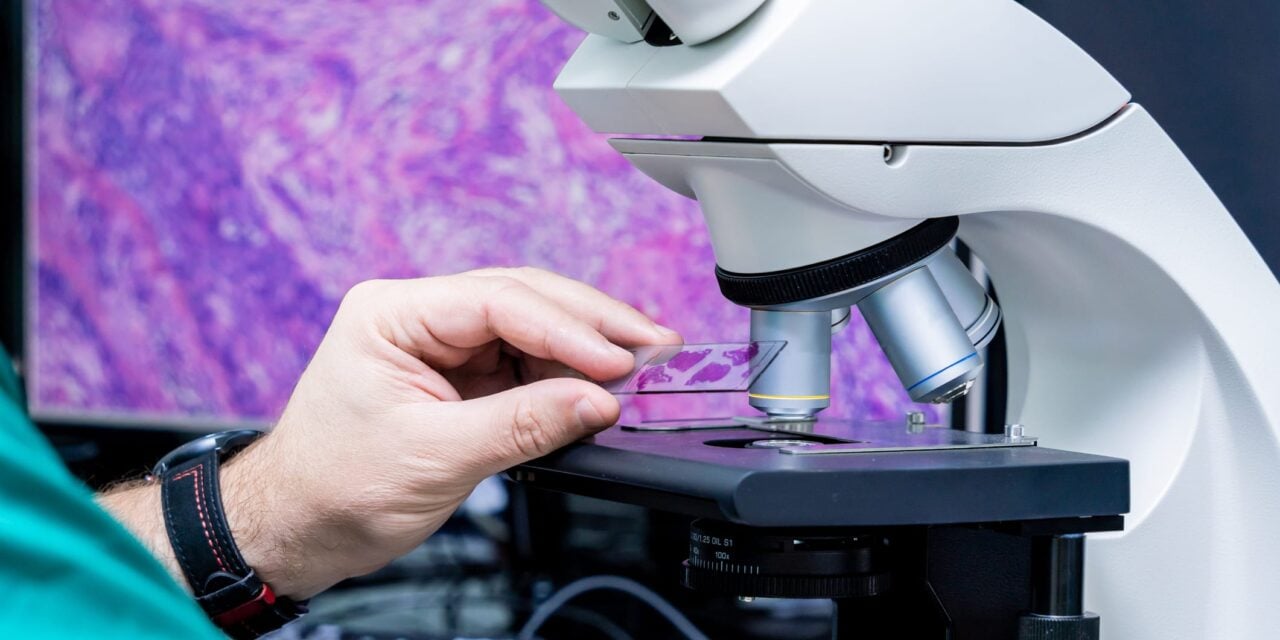
Cancer diagnostics are expanding as new approaches provide a broader view of tumor biology and disease progression.
By Alyx Arnett
For years, a cancer diagnosis often came down to one test, one gene, one mutation. Today, clinical laboratories are adopting broader approaches—including whole-genome sequencing, functional RNA profiling, liquid biopsy, and multi-omic testing—that provide more comprehensive molecular information and help clinicians monitor disease over time, expanding what they can learn from a tumor and how that information guides patient care.
“We are moving well beyond the traditional approach of testing a single mutation in a single gene,” says Luca Quagliata, PhD, corporate head of diagnostic medical and scientific affairs for the products and technology sector at Thermo Fisher Scientific.
Laboratories can now analyze multiple layers of disease biology, including DNA-level alterations such as mutations and methylation patterns, as well as RNA-level changes involving gene fusions, structural variants, and expression profiles, he says.
Broader Molecular Profiling
One of the clearest examples of broader molecular profiling is whole-genome sequencing.
Major healthcare systems are shifting toward implementing whole-genome sequencing as a single diagnostic baseline rather than testing genes sequentially, says Jehee Suh, CEO of Inocras, a precision oncology company specializing in whole-genome sequencing and bioinformatics. National initiatives, such as the United Kingdom’s 100,000 Genomes Project and the Netherlands’ Hartwig Medical Foundation, have demonstrated that whole-genome sequencing can be integrated into routine clinical care while matching the turnaround times of panel-based approaches.
According to Suh, whole-genome sequencing can identify multiple types of genomic alterations in a single test, including driver mutations, structural variants, germline variants, and genomic signatures such as homologous recombination deficiency.
As one example, Suh points to a recent study by Inocras and collaborators involving patients with high-grade serous ovarian cancer. Researchers found that patients with whole-genome sequencing-defined homologous recombination deficiency had significantly longer progression-free survival following first-line PARP inhibitor maintenance therapy than patients without whole-genome sequencing-defined homologous recombination deficiency.1
The study also found that about 21% of patients with BRCA-wildtype tumors were identified as homologous recombination deficiency-positive through whole-genome sequencing, suggesting BRCA-only testing may miss patients who could benefit from treatment.1
At the same time, laboratories are looking beyond DNA. “More recently, proteomic analysis is also becoming part of this broader diagnostic picture,” says Quagliata. Integrating these data types can provide a more complete picture of tumor biology and disease progression, including insights that genomics alone may not capture, he says.
As testing becomes more comprehensive, laboratories are also evaluating its overall value rather than the upfront cost of sequencing alone. “While a narrower assay may appear less expensive upfront, its overall value is limited if it misses key, clinically actionable findings,” Suh says. Missing those findings can lead to additional testing, delays, and unnecessary use of limited patient tissue.
Inocras’ CancerVision is one example of a platform built around that approach, evaluating multiple classes of genomic alterations in a single whole-genome workflow.
Looking Beyond DNA
Building a more complete molecular profile also means looking beyond DNA. At Agendia, one molecular diagnostics company taking this approach, chief medical officer William Audeh, MD, MS, says the shift is away from testing for a single biomarker and toward looking at which biological pathways are actually driving a tumor.
Pathology has long relied on immunohistochemistry to check whether a receptor is physically present on a cell, Audeh says. But “presence alone does not guarantee that the receptor is actively driving tumor growth.” Instead, Agendia’s molecular subtyping assay evaluates functional RNA expression to identify which biological pathways are driving the tumor. According to Audeh, the approach can identify biologically distinct tumors that standard immunohistochemistry groups together. It further classifies nearly 30% of estrogen receptor-positive, human epidermal growth factor receptor 2 (HER2)-negative tumors, including some that behave like more aggressive, basal-type cancers.2
DNA mutations alone do not always provide clear treatment answers. Most tumors lack actionable mutations, and those that do often become resistant as they evolve under treatment, Audeh says, even though targeted therapies have significantly improved outcomes for some patients. Gene expression profiling offers another way to characterize a tumor and help guide treatment decisions for patients with early-stage breast cancer, regardless of their DNA mutation profile.
Earlier this year, Agendia reported FLEX Study data showing its tests can identify which patients with hormone receptor-positive, HER2-negative early-stage breast cancer are most likely to benefit from anthracycline-based chemotherapy—a prediction standard pathology couldn’t make, Audeh says.3 The findings illustrate how gene expression profiling is being used to help guide treatment decisions, not just characterize tumors, he says.
Liquid Biopsy and Longitudinal Monitoring
Cancer diagnostics is also moving beyond a single test at diagnosis. Historically, molecular testing was treated as a snapshot taken at one point in time, but Thermo Fisher Scientific’s Quagliata expects that model will increasingly be replaced by a more dynamic approach in which molecular information is generated before, during, and after treatment. “The future will be longitudinal, dynamic, and integrated,” he says.
That evolution is becoming increasingly important as monitoring plays a larger role in precision oncology. Minimal residual disease, recurrence detection, and treatment resistance all require clinicians to understand how disease biology changes over time. A molecular profile at diagnosis may serve as the baseline, and “the future will be about returning to that baseline, comparing against it, and updating the molecular picture as the patient’s disease evolves,” Quagliata says.
Liquid biopsy and alternative sample approaches are helping make that possible by improving access to the right sample at the right time. Tissue is not always available or feasible to obtain repeatedly due to tumor location, patient frailty, disease progression, or prior tissue exhaustion. Blood-based testing expands access to molecular profiling when tissue is limited and makes repeat testing more realistic, Quagliata says.
“The future will not be tissue versus liquid biopsy,” he says. “It will be about using the right sample, at the right time, for the right clinical question, and enabling a more dynamic, longitudinal view of the patient’s disease.”
Suh says approaches such as Inocras’ MRDVision illustrate how testing is moving toward continuous assessment across the patient journey. The platform uses whole-genome information to detect and monitor molecular residual disease while reducing the likelihood of missing tumor signals that fall outside preselected targets.
Alternative sample approaches are also making repeated molecular testing more practical. One example comes from research at the Fred Hutchinson Cancer Center, where investigators demonstrated that next-generation sequencing of chronic myeloid leukemia can be completed using a simple dried blood spot, eliminating the need for cold shipping and laboratory phlebotomy.⁴ The researchers detected ABL1 mutations that could guide therapy in roughly one-third of patients while also identifying additional pathogenic variants.⁴
AI-Assisted Interpretation and Automation
As cancer diagnostics become more comprehensive, laboratories are facing growing operational demands, according to Quagliata. Comprehensive molecular profiling requires laboratories to validate assays, manage high-throughput workflows, ensure quality, and interpret increasingly complex results. At the same time, manual pathology workflows, tissue handling, batching, and staffing shortages can delay results.
Automation is helping laboratories address many of those challenges, like “capacity and staffing constraints by reducing hands-on time, simplifying workflows, and improving consistency,” Quagliata says. Thermo Fisher Scientific’s Ion Torrent Genexus System, for example, is designed to deliver next-day comprehensive genomic profiling while reducing the operational complexity and specialized expertise traditionally required for next-generation sequencing, making in-house testing more realistic for a broader range of laboratories, he says.
Beyond improving laboratory efficiency, speed also has direct clinical implications. “Turnaround time has become one of the most important issues in precision oncology because timing determines clinical utility,” Quagliata says. He notes that the 2022 European LeukemiaNet recommendations call for molecular results on actionable targets to be available within three to five days whenever possible.⁵ Automated genomic profiling can compress complex sequencing workflows from weeks to days, making molecular information available when treatment decisions are being made.
Beyond automating laboratory workflows, artificial intelligence is helping laboratories interpret the growing volume of data generated by comprehensive genomic testing. According to Suh, AI can help process, interpret, and prioritize genomic information, supporting variant interpretation, identifying patterns across multiple alteration types, and helping researchers discover new biomarkers.
“But AI is only as reliable as the data used to train and validate it,” Suh says, noting that large datasets must also account for consistency, clinical annotation, population diversity, and technical bias.
Developing reliable AI models also depends on large, well-characterized datasets. One example comes from Inocras’ recent collaboration with Broad Institute researchers to analyze whole-genome sequencing data from more than 8,000 cases in The Cancer Genome Atlas spanning more than 30 cancer types. The project expanded the detectable landscape of genomic variants, identifying more than 250 million variants—including new coding and non-coding candidate driver mutations, genomic signatures of chromosomal instability, and pathogenic germline variants in established cancer predisposition genes.
According to Suh, those datasets allow researchers to move “from isolated observations toward reproducible patterns” that may support new biomarkers and computational models.
AI applications also extend beyond genomic data. Audeh says pathology laboratories face growing pressure as tissue blocks are depleted when multiple vendors request samples for separate assays. AI-based tests can accelerate turnaround times, reduce costs, and preserve tissue when sample quantities are limited. But he emphasizes that “tests are only as good as the datasets on which they were trained,” making robust validation across diverse patient populations essential to reduce algorithmic bias and ensure reliable performance.
Putting New Tests Into Practice
As more diagnostic technologies become available, demonstrating clinical utility has become just as important as developing new tests.
Across whole-genome sequencing, RNA profiling, liquid biopsy, and AI-assisted analysis, “the greatest challenge today is no longer generating genomic data but ensuring that data is actionable for clinicians,” says Agendia’s Audeh. He says real-world evidence is becoming increasingly important for demonstrating how genomic tests influence treatment decisions and patient outcomes in routine clinical practice, particularly in patient populations that are difficult to study through traditional randomized trials.
Quagliata says the next phase of cancer diagnostics will build on those advances by combining broader molecular information with stronger clinical evidence.
“The goal will not be to ask one molecular question once, but to understand how the disease is evolving over time and how that evolution should inform care,” he says. “That is where diagnostics becomes truly next generation: not just broader panels, but deeper biological interpretation.”
References
- Lim J, Kim YN, Oh BB, et al. Whole-genome HRD phenotyping as a predictor of PARP inhibitor benefit in first-line maintenance high-grade serous ovarian cancer. J Clin Oncol. 2026;44(16 suppl):e17608.
- Whitworth PW, Beitsch PD, Pellicane JV, et al. Distinct neoadjuvant chemotherapy response and 5-year outcome in patients with estrogen receptor-positive, human epidermal growth factor receptor 2-negative breast tumors that reclassify as basal-type by the 80-gene signature. JCO Precis Oncol. 2022;6(1):e2100463.
- O’Shaughnessy J, Brufsky A, Graham CL, et al. Improved 3-year IDFS with anthracycline-based therapy for patients with 70-gene signature High 2, Luminal B, HR+/HER2- early-stage breast cancer. Presented at: San Antonio Breast Cancer Symposium; 2025 Dec 9-12; San Antonio, TX. Poster PS2-07-03.
- Oehler VG, Sala-Torra O, Gilderman N, et al. Next-generation sequencing from chronic myeloid leukemia dried blood spots: insights and implications for global oncology. Leukemia. 2026;40(3):587-93.
- Döhner H, Wei AH, Appelbaum FR, et al. Diagnosis and management of AML in adults: 2022 recommendations from an international expert panel on behalf of the ELN. Blood. 2022;140(12):1345-77.
ID 238459287 © Roman Zaiets | Dreamstime.com