The CLEAR-AD study highlights the need for platform-specific calibration for plasma p-tau217 assays to ensure diagnostic accuracy.
The Clinical Evaluation of Blood-Based Tests for the Rapid Identification of Amyloid Pathology in AD (CLEAR-AD) study found significant performance variations among nine commercially available plasma p-tau217 assays. The findings, published in Science Bulletin, indicate that these blood tests for Alzheimer’s disease are not a uniform diagnostic category and are not interchangeable across different analytical platforms.
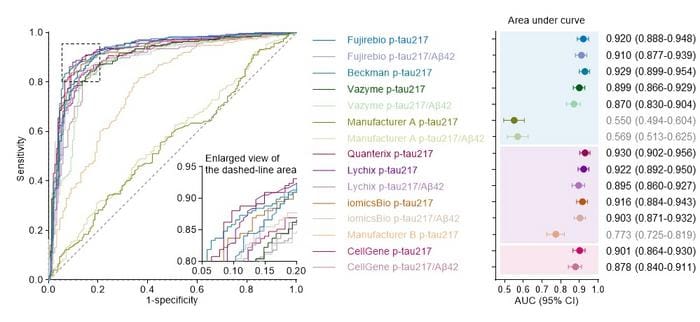
The multicenter diagnostic accuracy study included 431 participants from 10 memory clinics, including cognitively unimpaired individuals, patients with mild cognitive impairment, and patients with dementia. Researchers evaluated blood samples in a central laboratory using nine assays across three analytical platforms, benchmarking the results against brain amyloid positron emission tomography (PET) scans.
While seven of the nine assays showed strong accuracy in detecting amyloid PET positivity, two assays demonstrated substantially lower diagnostic discrimination. The study says that the clinical utility of a plasma p-tau217 test depends heavily on the specific analytical platform used. This is particularly relevant as the industry sees broader commercial adoption, such as Anthem’s coverage of Quanterix’s LucentAD test.
Calibration and Interpretation Strategies
The research team also evaluated a two-cutoff interpretation strategy designed to rule in or rule out amyloid pathology. For the top-performing assays, this approach maintained high diagnostic certainty while keeping intermediate, inconclusive results within a small, manageable range.
Additionally, the study found that adding plasma amyloid-beta measurements to derive a biomarker ratio provided diagnostic benefits only in specific patient subgroups, such as those with mild cognitive impairment.
External cutoffs recommended by manufacturers or prior studies showed variable performance in this independent cohort, according to the research. This reinforces the necessity of calibrating threshold values prior to real-world clinical implementation.
The CLEAR-AD study supports the clinical translation of high-performing plasma p-tau217 assays to streamline diagnostic workflows, provided that platform-specific calibration and standardized protocols are established. This aligns with ongoing efforts to integrate these diagnostics into clinical settings, such as UK primary care trials and studies evaluating their efficacy in specific patient populations like Down syndrome.
Photo caption: Overview of the CLEAR-AD study evaluating the diagnostic accuracy of nine commercial plasma p-tau217 assays against amyloid PET imaging in a multicenter memory clinic cohort.
Photo credit: Science Bulletin