New local deployment system lets labs run AI-generated stains directly on-site, without sending tissue images to external cloud infrastructure.
Pictor Labs has launched an on-premises deployment system for its AI-powered virtual staining technology, enabling pathology labs to generate digital stains locally and on demand without transmitting tissue images to external cloud environments. The system was unveiled at the United States and Canadian Academy of Pathology 2026 Annual Meeting in Los Angeles on March 23, 2026.
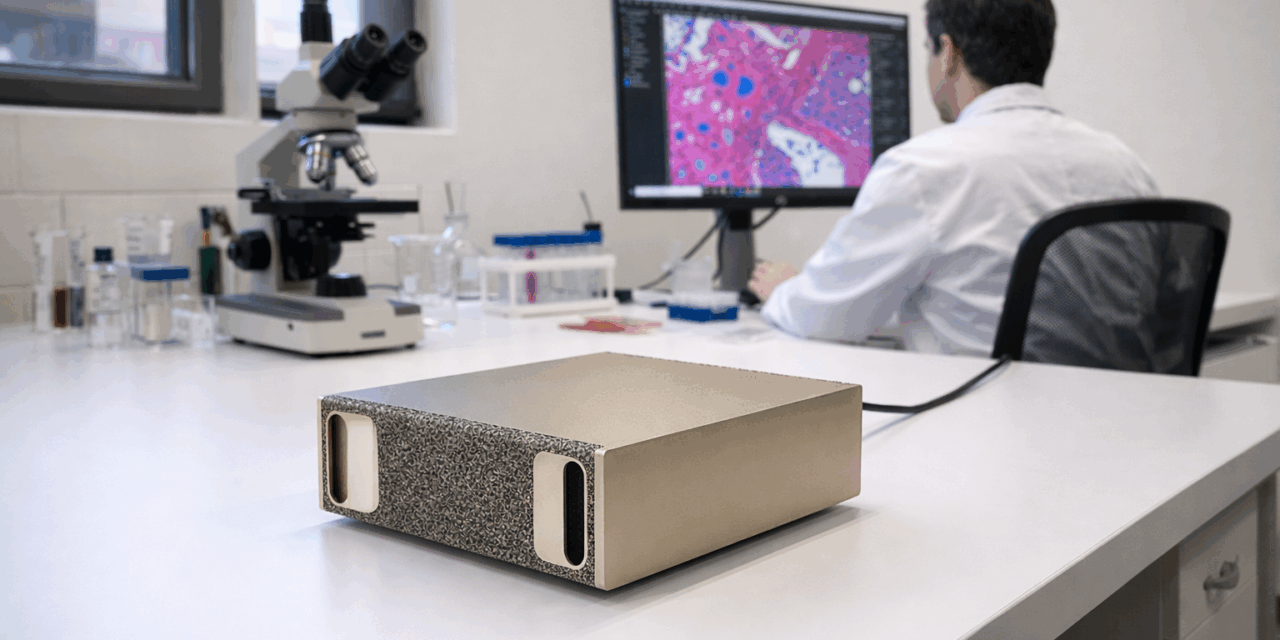
The dedicated hardware solution connects directly to existing slide scanners and image management systems, allowing labs to run Pictor Labs’ suite of virtual staining tools—ClearStain, ReStain, and DeepStain—within their own infrastructure. The system generates virtual hematoxylin and eosin, special stains, and immunohistochemistry stains using artificial intelligence (AI) inference run directly on the device, with results generated in seconds, according to a release from the company.
“Introducing on-prem deployment for virtual stains represents a major milestone in making AI-powered virtual staining accessible to every lab, regardless of their connectivity, compliance, or infrastructure constraints,” says Yair Rivenson, chief executive officer of Pictor Labs, in a release. “We’re excited to demonstrate what ‘deployable AI’ looks like—end-to-end, in a real workflow, right at the booth at USCAP.”
Designed for Data Control and Compliance
As pathology organizations face increasing regulatory scrutiny and data security requirements, Pictor Labs designed the on-prem system to keep tissue images within a lab’s own infrastructure. Because no data leaves the facility, the company says labs may be able to reduce the length and complexity of IT and security reviews compared to cloud-based deployments.
“We’re giving pathology labs the ability to run powerful, performance-evaluated AI models locally, securely, and at reliable high speeds while maintaining full control over data,” says Megan Rothney, PhD, vice president of product at Pictor Labs, in a release.
The system is inference-only, meaning it deploys performance-evaluated models in a production environment without performing model training or fine-tuning on site. According to the company, this approach is intended to ensure predictable performance and operational consistency across deployments.
Local Processing Eliminates Cloud Latency
Because AI inference occurs on the device itself, the system is not dependent on internet connectivity for operation, according to Pictor Labs. The company says this makes the hardware suitable for environments with limited bandwidth, unreliable internet access, or strict network security policies. Optional connectivity is available for software updates.
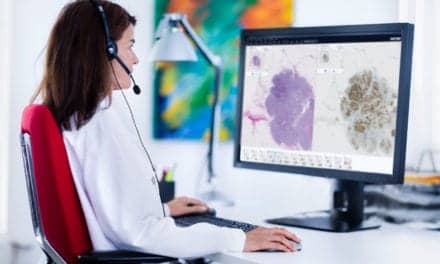
Virtual staining uses AI to generate digital pathology stains from standard brightfield images, enabling labs to preserve tissue while accelerating pathology workflows.
Flexible Deployment for Different Lab Environments
The on-premise hardware expands Pictor Labs’ available deployment options, which now include on-premise, cloud, and hybrid configurations. Labs can select the deployment model that best fits their operational needs, according to the company.
The system is designed to integrate with existing scanners and IMS platforms with minimal workflow disruption and without requiring custom IT build-out, the company says. Pictor Labs states it is the first to bring production-ready AI virtual staining to market through purpose-built hardware designed specifically for pathology workflows.
Photo caption: The virtual staining technology set up with a Grundium scanner
Photo credit: Pictor Labs
Related Reading:
Pictor Labs Launches ClearStain for Digital Sequencing Workflows
Proscia Integrates AI-Powered Virtual Staining Into Pathology Platform
Strategic Partnership Aims to Revolutionize Digital Pathology