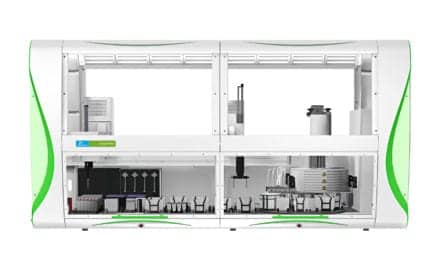
The G4X system can analyze 128 samples per run with 500-plex RNA and 18-plex protein capabilities, targeting translational research and clinical applications.
Singular Genomics announced the commercial launch of its G4X platform in the United States, marking the availability of what the company says is the industry’s highest-throughput system for spatial multiomics analysis.
The G4X platform enables simultaneous analysis of 500-plex RNA, 18-plex protein, and formalin-fixed, paraffin-embedded (FFPE) samples at subcellular resolution. The system can process 128 samples and 40 cm² per run, representing nearly 10-fold higher throughput than other commercially available systems, according to the company.
With sample-to-answer turnaround time of five days and per-sample costs in the low hundreds of dollars, the platform targets translational research, spatial pathology, and AI-driven analysis applications.
“The launch of G4X reflects a clear inflection point for spatial,” says Josh Stahl, CEO of Singular, in a release. “With the performance, scale, and affordability we’ve demonstrated, spatial analysis can now move beyond boutique experiments to power large cohorts, translational pipelines, and AI model development.”
Validation Across Academic Centers
The launch follows completion of an external early access program that validated performance across academic medical centers, research institutions, and biopharma partners. In the months before launch, the company completed validation testing across nearly 1,700 FFPE samples and 50 runs, profiling over 400 million cells and 50,000 mm² of tissue.
“We observed highly reproducible, run-to-run performance with strong specificity and consistent RNA and protein signal,” says Aaron Berlin, CTO of Singular, in a release. “That level of repeatability gives us confidence G4X can deliver high-quality cohort-scale, multimodal spatial datasets.”
Last year, the G4X platform processed nearly 20,000 FFPE samples, profiled approximately 4 billion spatially resolved single cells across dozens of sample types, and supported 25 technology access projects across multiple applications, according to a release from the company.
Clinical Research Applications
Early users report the platform’s capacity enables analysis of larger tissue sections without sacrificing resolution. The system can analyze up to 32 tissue sections per slide, according to the company.
“The ability of the G4X platform to generate spatial multimodal data across large patient cohorts while preserving tissue architecture represents an important advance for the field,” says Mariam Jamal-Hanjani, MD, PhD, professor of cancer genomics and metastasis at University College London, in a release. “Studying cancer at this scale is essential to better understand heterogeneity, evolution, and therapeutic resistance.”
Dan Delitto, MD, PhD, assistant professor of surgery at Stanford University, adds in a release, “The Singular G4X provides substantially increased spatial transcriptomic throughput without sacrificing precision. This expanded capacity allows us to analyze up to 32 tissue sections per slide, yielding stronger biological representation and more reliable insights.”
The platform has been installed across multiple sites in Singular’s Spatial Pathology Innovation Network following completion of the early access program at five academic medical centers.
Singular Genomics, headquartered in San Diego, will present launch details and data at the Advances in Genome Biology and Technology meeting in Orlando, Florida, Feb 23-26.
ID 25712658 © Xunbin Pan | Dreamstime.com