Researchers demonstrate that cfDNA fragmentation patterns can effectively diagnose and stage bladder cancer, potentially reducing reliance on invasive cystoscopies.
A new study suggests that analyzing cell-free DNA (cfDNA) fragmentation patterns in urine samples could provide a noninvasive alternative to cystoscopy for diagnosing and staging bladder cancer.
Researchers from Health Research Institute Hospital La Fe in Valencia, Spain, analyzed urine samples from 156 patients with bladder cancer and 79 matched controls. Using real-time PCR, they measured the concentration and integrity of cfDNA fragments from five genes: ACTB, AR, MYC, BCAS1, and STOX1. The study was published in The Journal of Molecular Diagnostics.
The team found that small fragments of the MYC gene showed 97% specificity and 88% predictive value for identifying muscle-invasive bladder cancer. MYC produces a transcription factor that regulates cell growth, proliferation, and metabolism.
“Our most significant finding was that the small fragment of the MYC gene may represent a valuable tool to diagnose bladder cancer, as it exhibited excellent specificity (97%) and predictive value (88%) for identifying muscle-invasive bladder cancer,” says lead investigator Pilar Medina, PhD, Haemostasis, Thrombosis, Arteriosclerosis and Vascular Biology Research Group at Health Research Institute Hospital La Fe, in a release.
Staging and Monitoring Applications
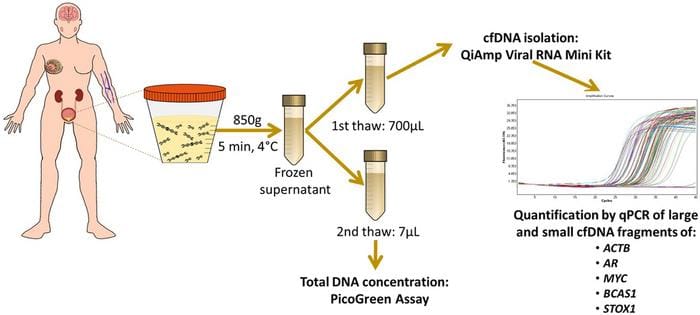
The researchers also identified potential staging biomarkers. The ratio of large to small fragments of the housekeeping gene ACTB and small fragments of the AR gene increased with disease severity, suggesting these could serve as reliable staging indicators. The integrity of these genes may also help identify bladder cancer relapse.
Current bladder cancer diagnosis relies heavily on cystoscopy, which involves inserting a thin, tube-like instrument through the urethra, or cytology testing. While cytology is noninvasive, it has limited sensitivity for detecting tumor cells shed in urine.
“This study is one of the first to comprehensively evaluate urine cfDNA fragmentation and integrity across most bladder cancer stages, bringing us closer to a future in which bladder cancer can be diagnosed and monitored through a simple urine test, improving patient comfort and care,” says lead author Raquel Herranz, MS, from the same research group, in a release.
Clinical Implications
Bladder cancer is among the most common urological cancers and has a high recurrence rate, making frequent monitoring necessary. The potential for a urine-based test could reduce healthcare costs and improve patient comfort by decreasing the need for repeated invasive procedures.
The approach aligns with growing interest in liquid biopsies and personalized medicine approaches in oncology diagnostics. However, the researchers note that further validation studies will be needed before the test can move toward clinical implementation.
“Our findings show that urine can tell us much more than we thought; it holds the potential to transform how we detect and manage bladder cancer,” says Medina in a release.
ID 208830277 © Montecristo9 | Dreamstime.com