Utah State researchers report new functions of Cas12a3 system that targets pathogen RNA without damaging host cell DNA.
Utah State University researchers have discovered new functions of the CRISPR-Cas12a3 bacterial immune system that could lead to more accurate diagnostic tools capable of detecting COVID-19, influenza, and RSV infections with a single test.
The findings, published in Nature, detail how Cas12a3 precisely targets transfer RNA in invading pathogens while sparing host cells, offering advantages over other CRISPR systems that can damage cellular DNA.
“Instead of making a single break in the bound target, as Cas9 does to DNA, RNA target binding by Cas12a2 and Cas12a3 changes the shape of a protein in a way that activates them to cut another nucleic acid target over and over again,” says Ryan Jackson, R. Gaurth Hansen associate professor in Utah State University’s Department of Chemistry and Biochemistry, in a release.
Targeting tRNA Without Cell Damage
Unlike the better-known CRISPR-Cas9 system that uses guide RNA to locate specific DNA sequences, Cas12a3 directly targets RNA. The research team found that when activated, Cas12a3 cleaves transfer ribonucleic acids (tRNAs), halting virus protein production while leaving host cell DNA intact.
“Cas12a3 can stop protein production in its tracks by chopping off a specific region of tRNA, called the ‘tail,’ which contains the amino acid,” Jackson says in a release. “This is a very powerful and precise way to prevent a pathogen, including a virus, from replicating in a cell, without damaging the cell’s DNA.”
This mechanism differs from the related Cas12a2 system, which indiscriminately cleaves DNA, destroying viral material but also killing host cells in the process.
Potential Diagnostic Applications
The research team, including doctoral student Kadin Crosby and master’s student Bamidele Filani, is working to harness Cas12a3’s ability to detect and target specific pathogens for diagnostic applications.
“tRNA is the lynchpin of protein synthesis,” Jackson says in a release. “It functions as a translation device that can read code on RNA and act as a molecular bridge to link that code to the correct amino acid to allow protein production.”
Jackson says Cas12a3’s ability to cleave tRNA tails represents a newly discovered CRISPR immune response that could offer therapeutic advantages.
“We think being able to stop an invading pathogen, while leaving DNA unchanged could be a therapeutic breakthrough,” he says in a release.
The study involved collaborators from multiple European institutions, including Germany’s Helmholtz Institute for RNA-based Infection Research, Helmholtz Center for Infection Research, and researchers from Poland, France, and Austria.
The research is supported by the R. Gaurth Hansen Family and the National Institutes of Health.
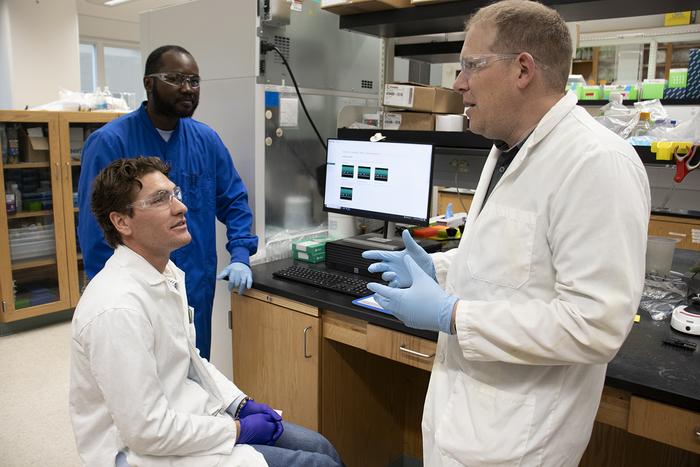
Photo caption: From left, Utah State University biochemists Kadin Crosby, Bamidele Filani and Ryan Jackson report newly discovered functions of the bacterial immune system CRISPR-Cas12a3 in the Jan. 7, 2026 issue of the journal Nature.
Photo credit: M. Muffoletto