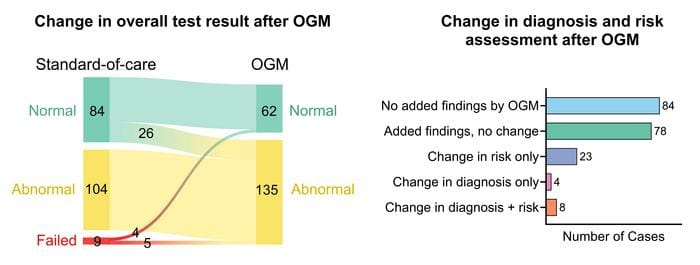
A new study of 200 patients found the technology identified significantly more clinically reportable variants than standard testing methods alone.
A new study has found that optical genome mapping (OGM) detected additional, clinically significant genetic variants in nearly 20% of acute leukemia patients whose standard diagnostic tests had returned incomplete or normal results, according to research published in The Journal of Molecular Diagnostics.
The study, conducted at Vancouver General Hospital, a tertiary care center in Canada, evaluated OGM’s performance across 200 adults with acute leukemia as part of a prospective clinical deployment alongside existing standard-of-care workflows. Researchers found that OGM identified more than 640 clinically reportable genetic variants, compared with 444 detected through the combined use of karyotype analysis, fluorescence in situ hybridization (FISH), and panel-based next-generation sequencing (NGS).
Those additional findings led to meaningful changes in diagnoses and risk stratification in a substantial subset of patients, directly informing therapy selection and expected outcomes.
“Our large Canadian tertiary care facility launched OGM as a new diagnostic test for adult individuals with acute leukemia alongside existing standard-of-care workflows. We analyzed the yield of this test in the first 200 patients and found that OGM offered remarkable utility, refining diagnosis or risk stratification in nearly 20% of cases by identifying critical genetic variants that were otherwise missed by traditional workflows,” says Tara Spence, PhD, FCCMG, FACMG, lead investigator and cytogenomicist at Vancouver General Hospital’s Department of Pathology and Laboratory Medicine, in a release.
Bridging Gaps in the Current Diagnostic Workflow
When a patient is diagnosed with acute leukemia, clinicians depend on genetic testing to determine disease subtype, guide treatment decisions, and establish prognosis. Current standard-of-care protocols require multiple tests to be run in parallel, and while their combined results illuminate the diagnostic picture in many cases, gaps remain.
OGM addresses those gaps by visualizing the entire genome in a single, unbiased pass, capturing genetic alterations across a broad spectrum of sizes and types—including copy number variants and structural abnormalities—that conventional tests may miss due to limitations in resolution or scope.
“The finding that nearly 20% of cases within our cohort had a clinically significant abnormality missed by standard testing was striking, and as a tertiary care center that supports acute leukemia referrals provincially, this yield likely reflects the unique patient population we serve,” says Spence, in a release.
A Complementary Tool, Not a Full Replacement—Yet
Despite OGM’s strong diagnostic performance, the authors note that it is not positioned to fully replace all components of the existing testing algorithm at this time. At Vancouver General Hospital, OGM’s longer turnaround time prevents it from supplanting karyotyping outright. However, the study’s findings justify its routine use as a complementary tool within the acute leukemia workup.
The research demonstrates that even without replacing standard tests, incorporating OGM alongside them produces substantial added clinical value—particularly in cases that would otherwise be reported as normal or inconclusive.
“This advanced clinical diagnostic technology offers the opportunity to meaningfully impact the individuals we serve, shedding light on genetic abnormalities that we previously could not visualize due to its incredibly refined resolution for detection of copy number and structural abnormalities. It is poised to guide treatment decisions and refine our understanding of expected outcomes. By sharing our experience and highlighting the additional diagnostic yield that OGM can provide, we hope to reduce barriers to implementation and support broader adoption of this powerful tool in clinical practice,” says Spence, in a release.
Photo caption: A study in The Journal of Molecular Diagnostics assessing the efficacy of OGM in a cohort of patients with acute leukemia has demonstrated that OGM provided reliable and robust analytical performance with high sensitivity and specificity in detecting genetic alterations. This image shows that OGM provided added clinical value compared with standard-of-care testing in adult acute leukemia by identifying clinically significant genetic abnormalities in cases initially reported as normal or where standard testing failed. These additional findings led to meaningful changes in the diagnoses and/or risk assessments for nearly 20% of individuals with acute leukemia seen at the investigators’ tertiary care center.
Photo credit: The Journal of Molecular Diagnostics / Parlow et al)