The sensor identifies misfolded protein biomarkers in blood before clinical symptoms of neurodegeneration appear.
Researchers at Ruhr-University Bochum developed an immuno-infrared sensor that detects Alzheimer’s and Parkinson’s disease in blood. The technology identifies misfolded protein biomarkers, which are early indicators of neurodegenerative processes that often occur before irreversible brain damage and clinical symptoms.
The sensor method uses specific antibodies to isolate misfolded biomarkers directly from body fluids, specifically amyloid beta for Alzheimer’s and alpha-synuclein for Parkinson’s. The misfolding is detected using infrared spectroscopy and quantum cascade laser technology.
“Because of this, there is a broad consensus in the scientific community that therapy needs to begin much sooner,” says Klaus Gerwert, professor at the Center for Protein Diagnostics at Ruhr University Bochum, in a release, “even before the typical insoluble protein deposits form in the brain—these being amyloid plaques in the case of Alzheimer’s, or Lewy bodies in Parkinson’s.”
Isolating Biomarkers via Infrared Spectroscopy
The technology utilizes a patented surface chemistry to immobilize antibodies on the sensor. A specialized blocking layer prevents non-specific binding to the surface, allowing the infrared spectrum of the biomarker to be isolated from the complex background spectrum of the body fluid using difference spectroscopy.
“These unique measurements are possible because of the combination of molecular biology, biophysics, and laser spectroscopy,” says Grischa Gerwert, lead author and researcher at Ruhr-University Bochum, in a release.
According to the researchers, the technology has potential for analyzing a variety of biomolecules in complex solutions. The use of quantum cascade laser technology also allows for parallel measurements.
“One special advantage of quantum cascade laser technology lies in its high scalability through parallel measurements,” says Gerwert in a release. “Consequently, this method holds promise for broad clinical application and population-wide screening in the future.”
Clinical Studies and Regulatory Approval
The immuno-infrared sensor is currently being used in clinical studies by BetaSENSE, a company founded by Klaus Gerwert. The company uses the technology to inspect new medications, including a vaccine against Parkinson’s disease, as part of contract research for the pharmaceutical industry.
For the blood test to be available for general public screening, it must obtain approval according to the European In Vitro Diagnostic Regulation (IVDR).
“At BetaSENSE, we are working hard to advance the approval process and make the test available to the public as soon as possible,” says Gerwert in a release.
The study detailing the sensor was published in The Journal of Physical Chemistry B. Researchers noted that the sensor could help shift the diagnostic focus from symptom-oriented identification to early detection, allowing for earlier therapeutic intervention.
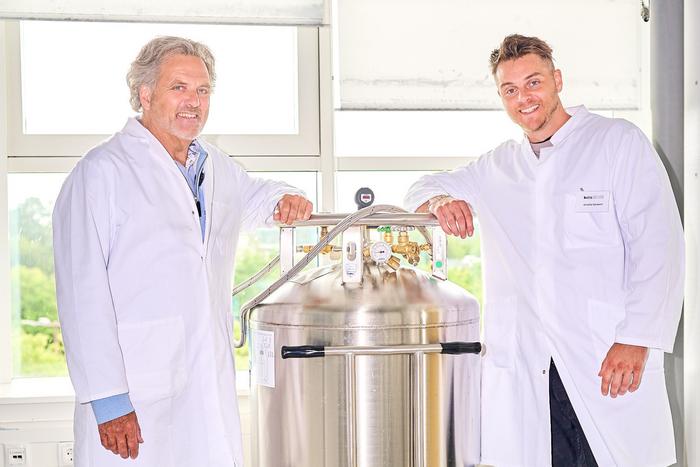
Photo caption: Klaus Gerwert and Grischa Gerwert in a betaSENSE laboratory
Photo credit: Dennis Yenmez/Stadt Bochum