The update integrates artificial intelligence into the system architecture to assist with case review, biomarker discovery, and laboratory operations.
Proscia has launched the fifth generation of its Concentriq platform, integrating artificial intelligence (AI) into the system architecture to support pathologists and scientists. The update is intended to help clinical laboratories manage heavy workloads and assist pharmaceutical researchers in making evidence-based decisions during drug development.
The new architecture utilizes domain-specific vision, language, and multimodal models. According to Proscia, this design allows the platform to unify images, metadata, and clinical context, including patient history and laboratory-specific protocols, to provide a complete view for case review and biomarker discovery.
“AI is advancing rapidly,” says Coleman Stavish, chief technology officer of Proscia, in a release. “We took a first-principles approach, working backwards from how pathologists and scientists operate. Years of learning from our customers has helped us understand where complexity slows them down and where judgment gets crowded out by process. Fifth generation is designed to reduce that burden so experts can focus on the decisions that matter most.”
Features for Diagnostic Laboratories
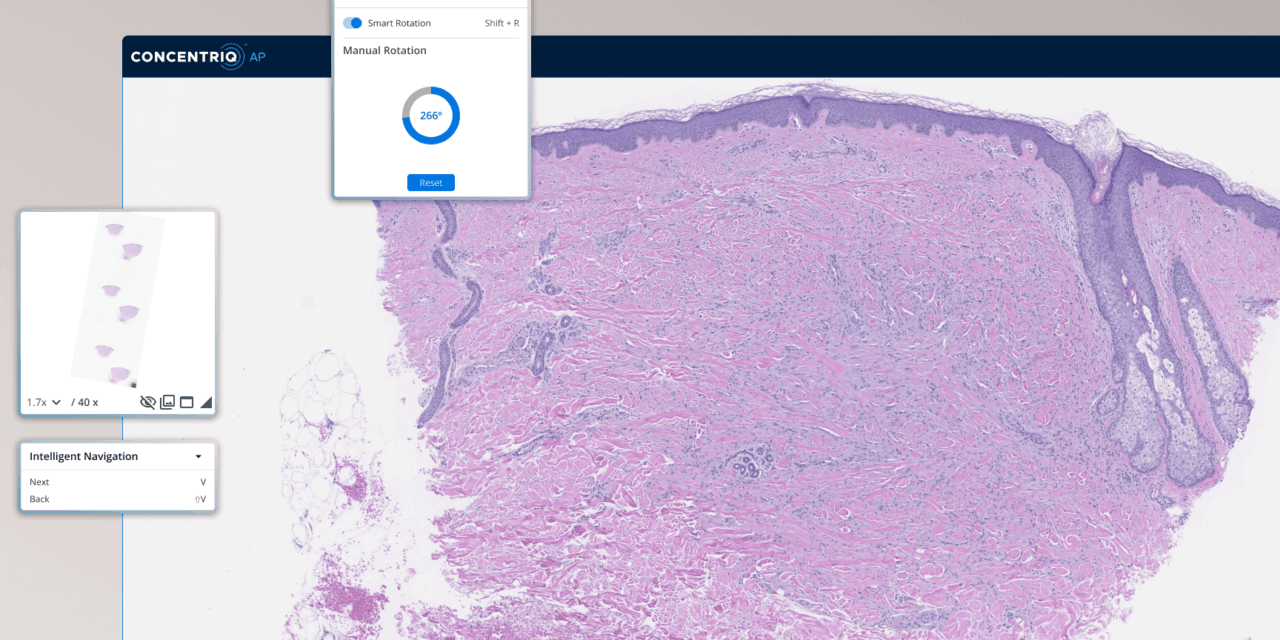
For clinical settings, the platform includes intelligent navigation tools designed to help pathologists move through tissue samples more efficiently. The system also integrates image analysis directly into the viewer, allowing for real-time updates of results and regions of interest.
The platform also aims to automate laboratory operations by balancing workloads, recommending stain panels, and identifying operational bottlenecks. Proscia, which serves diagnostic laboratories that manage 12 million patient cases annually, claims that automated storage tiering within the system can reduce long-term data storage costs by more than half.
“As one of the first laboratories to go digital, we’ve seen firsthand how technology reshapes pathology, and Concentriq has enabled that journey,” says Dr Derek Welch, president and chief medical officer of PathGroup, in a release. “Fifth generation applies AI in an entirely new way, removing the invisible labor that surrounds case review so pathologists can spend more time on the decisions that only they can make.”
Support for Research and Precision Medicine
For biopharmaceutical applications, the platform includes tools to help scientists search across tissue and clinical data using plain language. The system uses agents to propose analysis pipelines and identify potential biomarker candidates.
The update also includes molecular workflows, such as AI tumor detection and digital macro dissection, which are intended to help laboratories scale advanced testing and collaborate with biopharmaceutical companies on clinical trials and companion diagnostic development.
“We use Concentriq to run anatomic pathology testing for drug development across multiple laboratories on three continents,” says Dr John Cochran, vice president and chief medical officer at IQVIA Laboratories, in a release. “Proscia has a bold vision for what pathology software can be. Fifth generation applies that same thinking to AI, elevating pathologists and scientists and growing pathology’s role in precision medicine.”
The fifth generation of Concentriq is currently available to existing customers through an early access program. Proscia expects broader availability for the platform later this year.
Photo caption: Case review on the fifth generation of the Concentriq platform
Photo credit: Proscia