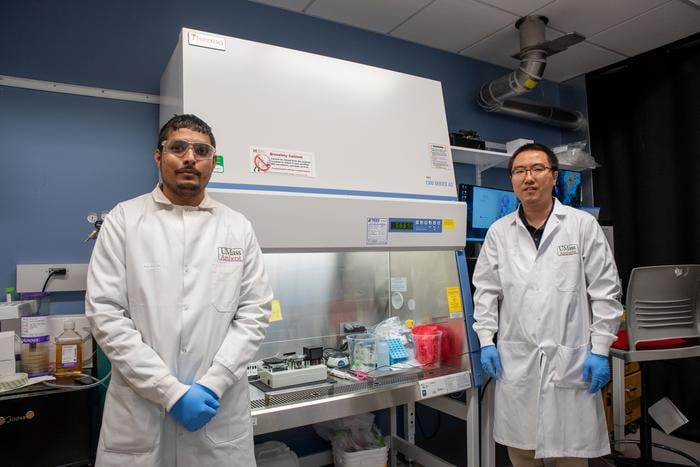
The device is designed to detect viral proteins at levels comparable to laboratory standards for early diagnosis.
Chang Liu, PhD, an associate professor in the Riccio College of Engineering at the University of Massachusetts Amherst, received a two-year, $1.3 million award from the National Institutes of Health (NIH) to advance the development of an at-home HIV test. The funding supports proof-of-concept work to create a device with sensitivity that meets or exceeds current laboratory standards.
While mortality related to AIDS has declined globally, approximately 1.3 million new infections occur annually. In the US, the “Ending the HIV Epidemic” initiative continues to address more than 30,000 new transmissions each year. A primary goal of the initiative is the “first 95” benchmark, which aims for 95% of people living with HIV to know their status. Currently, roughly 5.3 million individuals globally are unaware of their infection.
“This population serves as a silent reservoir of transmission,” says Liu, primary investigator of the research, in a release. “This lack of awareness of the HIV status is even more serious in resource-limited settings, such as rural areas within the US.”
Addressing Diagnostic Barriers
Access to sensitive diagnostic technology remains a significant barrier to meeting testing benchmarks. Most existing home self-tests measure HIV antibodies and typically require 25 days post-infection to provide a positive result. While polymerase chain reaction (PCR) tests that measure viral RNA can detect the virus within 10 days, they must be conducted in clinical settings, require specialized equipment, and involve higher costs.
A third testing method targets the p24 antigen, which are proteins shed by the virus. These tests have historically been considered too insensitive for early detection outside of a hospital or clinic. Liu and his colleagues developed a proprietary mechanism called Click Chemistry Amplified Nanopore (CAN) sensing to detect extremely low concentrations of the p24 antigen without the pre-processing required for PCR tests.
In initial validation studies involving patients, the prototype device detected the p24 antigen in 87.3% of patients with low viral loads. By comparison, enzyme-linked immunosorbent assay (ELISA) testing only detected the antigen in 18.2% of those patients. In patients with high viral loads, the device showed a 100% detection rate compared to 42.1% for ELISA.
Commercialization and Clinical Validation
The phase two NIH grant supports the refinement of the prototype design for commercialization. The work includes clinical validation for self-testing use with 300 patients at Prisma Health in South Carolina. This phase of the study is conducted in collaboration with Helmut Albrecht, medical director of the Center of Infectious Diseases Research and Policy at Prisma Health and the University of South Carolina.
In addition to initial screenings, the research will evaluate the ability of the device to track fluctuations in antigens for patients undergoing antiretroviral therapy.
“The device should be very easy for them to operate, even if they have limited education or no technical background,” says Liu, in a release.
The ultimate goal of the project is the creation of a spinoff startup to transition the technology from the university laboratory to public use.
Photo caption: Postdoctoral fellow,Rajiv Ranjan Thakur, left, and associate professor Chang Liu
Photo credit: UMass Amherst