Leica Biosystems launches the Aperio GT Elite scanner and Aperio iQC software, pairing high-speed slide imaging with automated quality control to reduce rework and support lab efficiency.
Leica Biosystems has launched the Aperio GT Elite scanner and Aperio iQC software in the US, designed to reduce manual intervention, automate quality control (QC), and streamline digital pathology workflows.
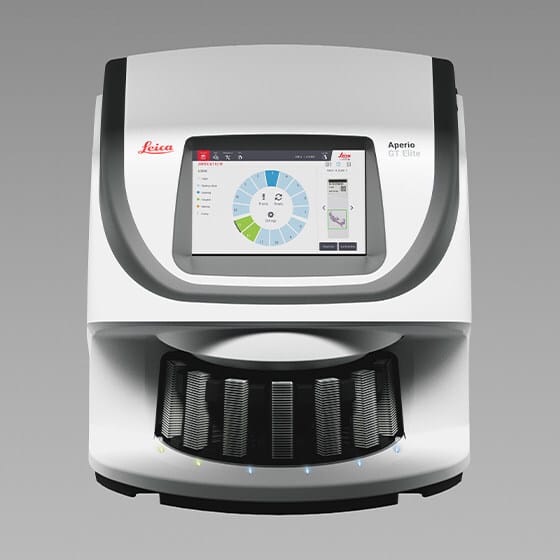
The Aperio GT Elite scanner is engineered for high-throughput research environments where speed and image consistency are critical. The system is designed to minimize the manual steps that typically slow digital pathology pipelines, delivering what the company describes as “first-pass confidence at scale,” according to a release.
“Time is the new currency in pathology; from slide preparation to analysis, every moment influences personal outcomes,” says Naveen Chandra, vice president and general manager of digital pathology at Leica Biosystems, in a release. “The Aperio GT Elite scanner paired with Aperio iQC software empowers labs to address issues early, reduce rework, and deliver consistent image quality.”
AI-Powered Quality Control Built Into the Scanning Workflow
When paired with Aperio iQC software, the Aperio GT Elite scanner brings artificial intelligence (AI)-powered QC into the scanning process. The software automatically detects common whole-slide imaging artifacts and alerts users while slides are still on the scanner—before issues escalate into costly or time-consuming rework, according to the company.
The software’s rescan functionality is a key differentiator, according to the company, enabling labs to identify and address imaging problems at the point of acquisition rather than after slides have been unloaded and reviewed downstream.
Manual QC for whole slide imaging typically costs laboratories approximately $1 per slide in technician time alone, according to the company. Across high-volume workflows, these routine checks can increase operational expenses while compounding the workload of laboratory staff—particularly during the ongoing shortage of qualified histotechnologists. By automating repetitive QC steps, Aperio iQC software is designed to free staff to redirect their expertise toward higher-value tasks that contribute directly to quality and lab efficiency, according to the company.
The software also aims to address a longstanding limitation of manual review: subjectivity. By standardizing and automating QC, Aperio iQC software delivers reproducible results that eliminate variability inherent in human assessment, according to the company.
Designed for the Computational Pathology Ecosystem
Leica Biosystems positions the Aperio GT Elite scanner and Aperio iQC software as purpose-built for integration within the broader computational pathology ecosystem, combining advanced imaging, AI-ready analytics, and workflow automation within a single platform.
“As the only company providing fully integrated, end-to-end solutions across the anatomic pathology lab, Leica Biosystems enables nearly 2 million cancer tests around the world every week, giving us unique insights into the pressures today’s laboratories and their teams face,” says Gustavo Perez-Fernandez, president at Leica Biosystems, in a release. “Our Aperio GT Elite scanner and Aperio iQC software are designed to fit seamlessly within the computational pathology ecosystem, combining advanced imaging, AI-ready analytics, and workflow automation to deliver first-pass confidence at scale.”
Both the Aperio GT Elite scanner and Aperio iQC software are designated for research use only and are not intended for use in diagnostic procedures.
Photo caption: Aperio GT Elite scanner
Photo credit: Leica Biosystems
Related Reading:
- Sakura Finetek and Hamamatsu Photonics Partner to Advance End-to-End Digital Pathology Workflows
- Vieworks Debuts Dual-Application Slide Scanner for Cytology and Histology
- Ibex Medical Analytics Launches Next-Generation AI Pathology Platform
- Philips Launches Cloud-Based Digital Pathology Solution Powered by AWS