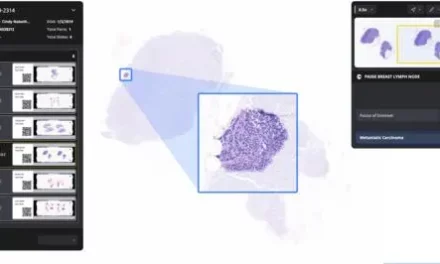
Three abstracts showcase PreciseBreast’s ability to predict recurrence risk in early-stage invasive breast cancer using digital pathology.
PreciseDx presented three abstracts at the 2025 San Antonio Breast Cancer Symposium demonstrating new validation data for PreciseBreast, an AI-powered digital pathology test designed to predict breast cancer recurrence risk.
The presentations, which took place from Dec 9-12 in San Antonio, Texas, showcased the test’s ability to assess recurrence risk in early-stage breast cancer patients. PreciseBreast uses proprietary AI technology to combine image feature data with clinical factors, generating a PreciseBreast Score that stratifies patients by recurrence risk.
Two abstracts were presented by PreciseDx, including clinical validation data showing the test can predict recurrence risk using biopsy specimens from patients with invasive breast cancer. A second presentation will focus on a novel approach for phenotyping triple-negative breast cancer using the AI platform to assess both recurrence risk and therapy response.
A third abstract from Lankenau Medical Center/Main Line Health presented prospective evaluation data of the PreciseBreast AI tool in early-stage invasive breast cancer risk stratification, representing independent, real-world clinical experience.
“These results build on our prior publications validating PreciseBreast’s clinical and analytical accuracy in early-stage invasive breast cancer by demonstrating the ability to use the patient’s biopsy specimen to risk stratify as well as advancing our understanding of patients with triple negative breast cancer,” says Eric Converse, chief executive officer of PreciseDx, in a release.
The company says it is particularly focused on the independent real-world experience at Lankenau Medical Center using PreciseBreast in patients with hormone receptor-positive, HER2-negative early breast cancer. PreciseDx is also continuing collaboration with NSABP to evaluate the test’s ability to predict chemotherapy benefit in this patient population.
The presentations represent ongoing efforts to demonstrate PreciseBreast’s ability to predict treatment benefit beyond recurrence risk assessment. The AI platform analyzes digital pathology images to identify features that may not be visible to pathologists using traditional microscopy methods.
Digital pathology-based AI tools are gaining attention in oncology as laboratories seek to provide more precise prognostic information to guide treatment decisions. These tools typically require integration with existing laboratory workflows and digital pathology infrastructure.
ID 51091429 | Breast Cancer © Llucky78 | Dreamstime.com