
The four-variable model performed well in a study of more than 23,000 patients, potentially reducing testing complexity by eliminating one biomarker.
Researchers in China have developed and validated GADA, a simplified model for detecting hepatocellular carcinoma (HCC) in patients with hepatitis B virus (HBV)–related chronic liver disease. The model combines gender, age, des-gamma-carboxy prothrombin (DCP, also known as PIVKA-II), and alpha-fetoprotein (AFP). It is derived from the GALAD model, which also includes the AFP-L3% biomarker. The study, led by Fengmin Lu, a professor at Peking University Health Science Center, is published in the Chinese Medical Journal.
The investigators note that chronic HBV infection causes more than 40% of HCC cases worldwide and is associated with approximately 86% of HCC cases in China. In many Western cohorts, hepatitis C, alcohol-related liver disease, and metabolic liver disease play a larger role. GALAD has performed well in several Western populations, but its performance required reassessment in HBV-associated chronic liver disease.
AFP-L3% also presents practical hurdles. According to the researchers, it adds measurement complexity, cost, and sample-volume requirements, and is not readily available in all clinical settings.
Study Design
The team analyzed 2,190 adults with HBV-related chronic liver disease at Mengchao Hepatobiliary Hospital of Fujian Medical University. They randomly assigned participants to a modeling cohort of 1,533 (70%) and an internal validation cohort of 657 (30%).
A separate prospective external validation cohort enrolled 20,908 participants at 10 hospitals across China, including 905 patients with newly diagnosed HCC and 20,003 patients without HCC. The patients without HCC included 17,802 with chronic hepatitis B and 2,201 with HBV-related cirrhosis. In total, the study included 23,098 participants.
AFP and DCP provided complementary diagnostic information, the researchers found, while AFP-L3% contributed limited additional utility in this HBV-focused population. That finding led them to the four-variable GADA score.
Diagnostic Performance
GADA posted the following results for overall HCC detection, according to the study:
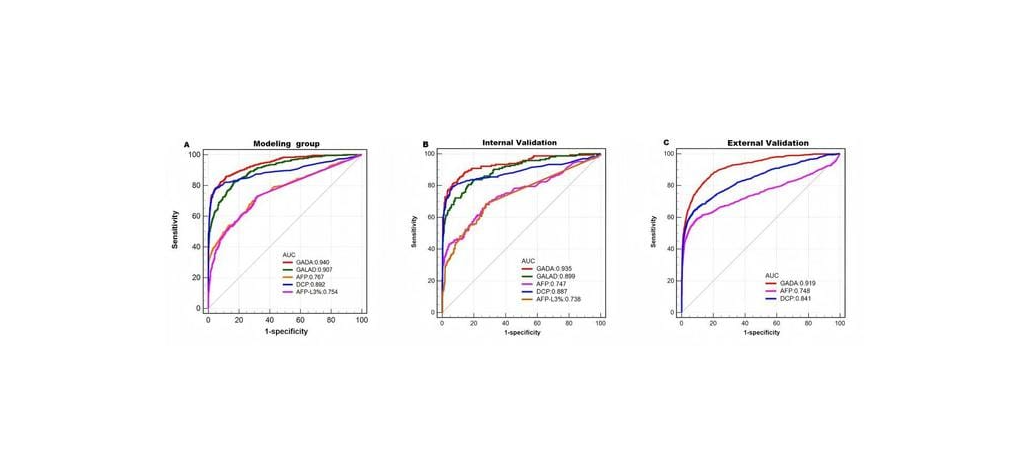
- Modeling cohort: area under the curve (AUC) of 0.940, with 82.57% sensitivity and 91.53% specificity.
- Internal validation cohort: AUC of 0.935, with 82.04% sensitivity and 92.65% specificity.
- External validation cohort: AUC of 0.919, with 86.00% sensitivity and 81.88% specificity.
In the modeling cohort, GADA outperformed the original GALAD model, with an AUC of 0.940 vs 0.907. In the external cohort, it also outperformed AFP alone (AUC 0.748) and DCP alone (AUC 0.841). AUCs at individual centers ranged from 0.895 to 0.977, which the researchers say supports the model’s robustness across geographically and clinically diverse settings.
For early-stage HCC meeting the Milan criteria, GADA achieved AUCs of 0.858 in the modeling cohort, 0.868 in the internal validation cohort, and 0.903 in the external validation cohort. In the external cohort, sensitivity was 88.16% and specificity was 74.50%.
Implications for the Laboratory
GADA targets the setting where the clinical need is greatest in China: distinguishing HBV-related HCC from chronic hepatitis B and HBV-related cirrhosis. By removing AFP-L3% while preserving diagnostic accuracy, the model may reduce testing complexity and improve accessibility, including in hospitals with more limited laboratory resources.
The authors caution that GADA should be viewed as an adjunct to established HCC surveillance and diagnostic pathways, not a replacement for imaging or clinical assessment. Before broad implementation, they say, prospective evaluation in routine surveillance populations and calibration of operational thresholds across laboratories will be important.
Photo caption: (A) Modeling cohort. (B) Internal validation cohort. (C) External validation cohort. AUC, area under the receiver operating characteristic curve; AFP, alpha-fetoprotein; AFP-L3%, lens culinaris agglutinin-reactive AFP; DCP, des-gamma-carboxy prothrombin.
Credit: Chinese Medical Journal. Prof. Fengmin Lu from Peking University Health Science Center, China; Dr. Lijuan Liu from Fujian Medical University, China; and Dr. Mei Zhang from Medical College of Shihezi University, China