New studies from Charité and DPZ establish reference standards to accelerate molecular diagnostics and assess Ebola vaccine cross-neutralization during the 2026 outbreak.
An international collaborative network of nine laboratories evaluated four candidate PCR tests from two diagnostic manufacturers in two weeks during the 2026 Bundibugyo virus outbreak, according to a study published in The Lancet Infectious Diseases and reported in a release from the German Center for Infection Research (DZIF).
The research, led by investigators at Charité – Universitätsmedizin Berlin and the German Primate Center (DPZ) – Leibniz Institute for Primate Research in Göttingen, addresses key diagnostic and immunological hurdles posed by Bundibugyo virus (BDBV). BDBV causes severe hemorrhagic fever, but unlike Ebola virus, there are currently no licensed vaccines, targeted therapeutics, or certified diagnostics designed to detect the species, according to the researchers.
Recent regulatory updates in the EU require standalone validation studies for new molecular assays, which can delay test deployment during public health emergencies, the study authors noted.
Establishing Reference Standards for Rapid PCR Validation
The diagnostic response began after Charité admitted a US patient on May 20, 2026, who had contracted BDBV in the Democratic Republic of the Congo, according to the release. From a patient throat swab, researchers led by professor Christian Drosten isolated viral genetic material to develop a reference standard benchmark for test verification.
Drosten’s team then coordinated an analytical validation across nine institutions, including members of DZIF, the German National University Medicine Network (NUM), European research consortia, university medical centers, and biosafety level-4 (BSL-4) facilities. The laboratory network completed analytical and clinical performance assessments for all four PCR assays within two weeks, identifying no cross-reactivity, according to the published findings.
Public funding could help accelerate the regulatory evaluation of diagnostic tests for rare, high-consequence pathogens, where commercial incentives are limited, according to study author Christian Drosten, a DZIF scientist.
Analyzing Viral Entry and Vaccine Cross-Protection
A companion study led by professor Stefan Pöhlmann at DPZ examined the infectivity of the 2026 BDBV strain, according to the DZIF release. Because handling authentic BDBV requires high-containment BSL-4 facilities, the team generated pseudovirus particles bearing the surface glycoproteins of BDBV strains from 2007–08, 2012, and 2026. The researchers found no evidence that the 2026 variant enters human host cells more efficiently than earlier lineages.
The investigators also evaluated whether existing Ebola countermeasures could provide cross-reactive immunity. Analyzing serum from 10 healthy volunteers vaccinated with the licensed recombinant VSV-ZEBOV Ebola vaccine, the team tested samples before vaccination and at 28 and 180 days post-vaccination.
According to the study, neutralizing antibodies against pseudoviruses representing all three BDBV strains were detected in six of the 10 vaccinated individuals at both time points. However, neutralizing titers against BDBV were 3.5- to 3.6-fold lower than titers measured against Ebola virus.
The authors emphasized that because the neutralization assays utilized in vitro pseudovirus models, the findings require confirmation with authentic virus isolates and do not establish clinical protection in human populations. Both research teams concluded that establishing decentralized laboratory networks, standardized reference samples, and dedicated regulatory pathways in advance remains critical to reducing time to diagnostic readiness during emerging filovirus outbreaks.
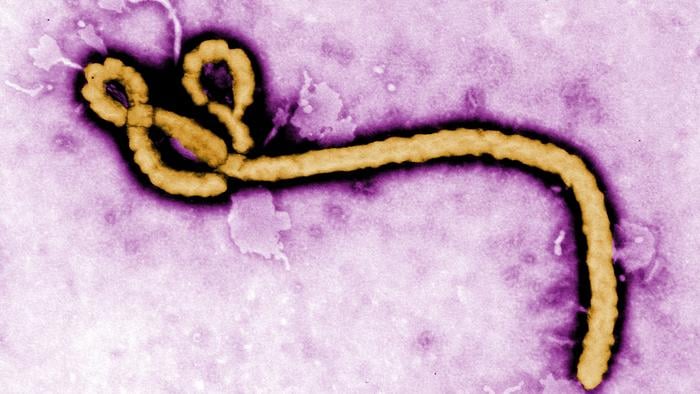
Photo caption: Colorized transmission electron micrograph of an Ebola virus virion.
Photo credit: CDC/Frederick A. Murphy