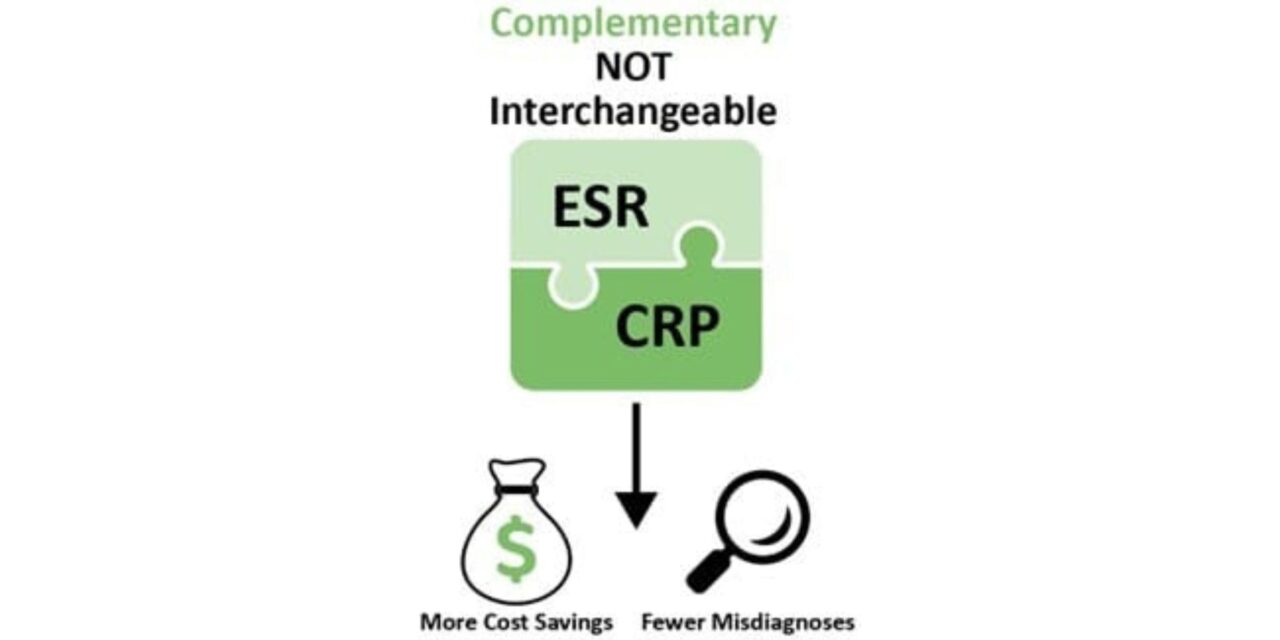
A peer-reviewed economic analysis challenges the assumption that erythrocyte sedimentation rate and C-reactive protein tests are interchangeable, finding that combined testing reduces misdiagnoses and lowers overall costs.
A new peer-reviewed economic analysis is pushing back against decades of pressure to eliminate erythrocyte sedimentation rate (ESR) testing from clinical laboratories, finding that combining ESR with C-reactive protein (CRP) testing not only reduces misdiagnoses but also generates substantial net cost savings compared to ordering CRP alone.
Published in ClinicoEconomics and Outcomes Research, the study projects that a representative 739-bed academic medical center in the US could realize net annual savings of $9.95 million by adopting a combined ESR and CRP testing strategy—savings driven primarily by avoided unnecessary workup stemming from false positives associated with CRP alone.
The study was sponsored by ALCOR Scientific.
Different Tests, Different Clinical Windows
A core argument for eliminating ESR has been that CRP and ESR measure the same thing. The study challenges that assumption directly.
“The kinetics of CRP and ESR are fundamentally different,” the authors note in the study. CRP rises rapidly within hours of acute inflammation and returns to normal within days. ESR, by contrast, increases more slowly over 24 to 48 hours and remains elevated longer—making it particularly valuable for detecting chronic and subacute inflammatory conditions such as polymyalgia rheumatica, giant cell arteritis, lupus, and certain malignancies.
These biological differences mean the two tests provide complementary clinical information, and that using both—when interpreted correctly—improves diagnostic accuracy in ways a single marker cannot replicate.
Study Design and Methodology
The analysis used a decision-tree economic model simulating cohorts of 100 patients, evaluated from the US healthcare system payer perspective. Eight conditions were included: rheumatoid arthritis, inflammatory bowel disease, periprosthetic joint infection, giant cell arteritis, pancreatitis, infection, autoimmune disorders, and cancer.
Sensitivity and specificity data were drawn from published clinical literature. Costs were sourced from Centers for Medicare and Medicaid Services reimbursement rates—ESR is reimbursed at $2.70 per test and CRP at $5.18. Follow-up costs for misdiagnoses were derived from US clinical guidelines and validated by clinicians. Results remained robust across scenario analyses that varied test costs, follow-up costs, and diagnostic accuracy inputs.
Revisiting the ‘Choosing Wisely’ Rationale
The findings arrive at a significant moment for value-based care. The former “Choosing Wisely” initiative pressured hospitals to eliminate what it characterized as redundant laboratory testing, and ESR was frequently cited as a target for elimination.
The study’s authors argue that this framing has not kept pace with the realities of modern laboratory technology. Automated ESR testing no longer requires meaningful hands-on time in the clinical lab, and at a reimbursement rate of $2.70 per test, the incremental cost of ordering ESR alongside CRP is minimal.
“Modern ESR analyzers are fast, automated, and inexpensive,” the authors write. “The older argument that ESR is burdensome to laboratory resources no longer holds. The question is whether the diagnostic value justifies the cost—and for the ESR + CRP strategy, the answer is clearly yes.”
The study also notes that the “Choosing Wisely” initiative was established when ESR was still a largely manual test and when evidence on the financial impact to health systems was minimal—two factors that have changed substantially since then.
The Cost Equation
With laboratory testing costs typically falling below the reimbursement rate, the cost-effectiveness argument for combined testing is further strengthened. The return on the incremental investment in ESR—in the form of avoided misdiagnoses and their downstream follow-up costs—is, according to the authors, orders of magnitude greater than the cost of the test itself.
Photo caption: ESR and CRP are complementary, a new study concludes.
Photo credit: Alcor Scientific