
New platform delivers twice the throughput in half the footprint of the previous generation, targeting large-scale genomic applications.
Ultima Genomics Inc introduced its UG200 Series sequencing instruments and Solaris 2.0 workflows, delivering twice the output of its UG 100 system while reducing footprint by half and enabling one-day turnaround from library to data, according to a release from the company.
The Fremont, California-based company announced the products at the Advances in Genome Biology and Technology Conference, positioning the technology for applications including cancer monitoring, AI-powered discovery, and population-scale genomics.
“The UG200 Series and Solaris 2.0 represent a major milestone in our mission to drive sequencing at scale with another leap forward in throughput, cost, automation, and accessibility,” says Gilad Almogy, founder and CEO of Ultima Genomics, in a release.
Two System Configurations Available
The UG200 Series includes two configurations: the UG200 and UG200 Ultra, allowing customers to select systems matching their throughput requirements. The systems have been in early access and are now available for purchase, with shipments beginning in the second quarter of 2026.
The new Solaris 2.0 workflows use next-generation amplification technology to improve coverage uniformity and performance in complex genomic regions while maintaining what the company calls “extreme SNVQ-60 accuracy.” The technology eliminates the need for emulsions and separate ePCR amplification stations used in previous versions.
Customers can deploy sample preparation and amplification steps directly on existing liquid handling platforms or purchase an optimized benchtop liquid handler. Solaris 2.0 workflows are available for purchase immediately.
Enhanced Output Options Coming
Ultima also announced Solaris 2.0 Max, scheduled for the second half of 2026, which will provide up to 20 billion reads per wafer—double the output of existing Solaris workflows. The system will include 10 billion “half wafer” and 5 billion “quarter wafer” configurations for enhanced flexibility.
The 20 billion reads per wafer will enable sequencing of more than 60,000 30x coverage whole genomes annually on a single UG200 Ultra instrument, according to the company.
Paired-end sequencing capabilities will also launch on the UG200 Series, with details to be announced by year end.
Existing Customer Support
Ultima will make Solaris 2.0 workflows compatible with existing UG 100 instruments through in-field upgrades to UG 100 Plus configurations. With Solaris 2.0 Max, the UG 100 Plus will have nearly four times the annual production compared to the UG 100 at its initial commercial launch.
“We are running our UG 100 fleet in full production, handling over 100,000 whole genome samples a month,” says Dr Arjan Bormans, chief scientific officer of Gene by Gene, in a release. “The smaller footprint and faster turnaround fit our high-throughput setup, and we moved it from testing to full production in under a quarter.”
Dr Carl Anderson, head of human genetics at the Wellcome Sanger Institute, says the move from UG 100 to UG200 “supports our mission to generate longitudinal multiomics data linked to deep phenotypes, making whole genome sequencing routine for cohorts that were previously constrained to targeted panels.”
The company develops ultra-high-throughput sequencing systems designed to scale beyond conventional sequencing technologies and reduce genomic information costs.
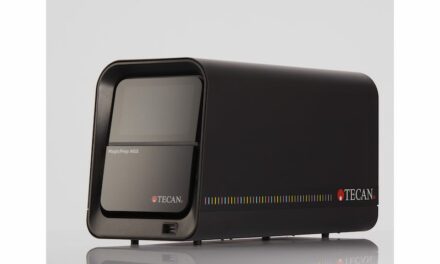
Photo caption: UG200 Series
Photo credit: Ultima Genomics
We Recommend for You: