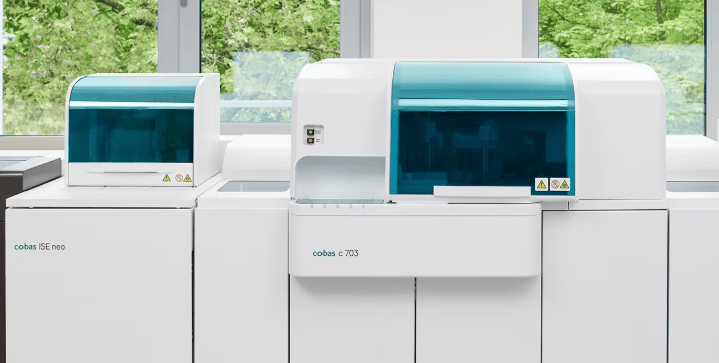
The cobas c 703 and cobas ISE neo units offer increased automation, higher test volumes, and reduced hands-on time as part of Roche’s modular cobas pro integrated solutions platform.
The Food and Drug Administration (FDA) has cleared two new analytical units from Roche—the cobas c 703 and the cobas ISE neo—designed to help manage rising test volumes, staff shortages, and space constraints. Both units are additions to the company’s scalable cobas pro integrated solutions platform.
The cobas c 703 delivers up to 2,000 clinical chemistry tests per hour—double the throughput of previous cobas pro integrated solutions units—along with 70 reagent positions designed to reduce reload interruptions and keep high-value tests running continuously. Monthly operator maintenance is intended to maximize uptime and limit workflow disruptions.
The cobas ISE neo processes up to 1,800 tests per hour and automates routine maintenance tasks that were previously performed manually. The unit also delivers more tests per reagent bottle compared to prior-generation systems, according to Roche, which the company says reduces plastic waste and simplifies logistics.
“Laboratories are the indispensable engine of modern healthcare, and Roche wants to partner in addressing staffing-shortage challenges and an ever-increasing demand for testing,” says Brad Moore, president and CEO of Roche Diagnostics North America, in a release. “Roche is investing in solutions that help labs process more samples than ever—without sacrificing performance. The high-volume clinical chemistry and enhanced automation of the cobas c 703 and cobas ISE neo analytical units will streamline workflows, one test at a time.”
Part of a Broader Modular Platform
Both units slot into the existing cobas pro integrated solutions ecosystem, which launched in the US in 2020 and is built to serve mid- to very-high-volume clinical chemistry and immunochemistry testing needs. The platform features intelligent sample routing, fast STAT assay incubation times, and what Roche describes as the broadest test menu on an integrated platform.
Shared and standardized reagents across cobas pro and cobas pure integrated solutions enable flexible staff assignment and reduce training requirements across sites, according to Roche. Since the platform’s launch, the required sample volume per test has been reduced by 43% on average compared to previous-generation systems, and plastic generated per test result has been reduced by up to 78% due to smaller reagent pack sizes and a higher number of tests per pack, per the company.
Photo caption: cobas c 703 and cobas ISE Neo Analytical Units
Photo credit: Roche
We Recommend for You:
Roche Launches Respiratory Pathogen Panel With Flexible Syndromic Testing for CE Markets
Roche’s Mass Spectrometry Steroid Assays Receive FDA Moderate Complexity Designation
New High-Throughput Scanner and AI-Powered QC Software Aim to Accelerate Digital Pathology Workflows