The new technology identifies the tumor’s biological fingerprint with more than 90% accuracy and could complement CT scans in monitoring patients’ response to treatment.
Researchers at Tel Aviv University have developed a fast, low-cost blood test that diagnoses lung cancer by identifying a chemical fingerprint in cell-free DNA, bypassing the need for DNA sequencing.
The study, published in Nature Precision Oncology, demonstrates that the test distinguished between lung cancer patients and healthy individuals with a sensitivity of 93.1% and a specificity of 90.3% for patients with stage 2-4 disease. The research was led by Yuval Ebenstein, a professor at the school of chemistry at the faculty of exact sciences, the department of biomedical engineering, and the Zimin Institute at Tel Aviv University, in collaboration with researchers from JaxBio Technologies, Bnai Zion Medical Center, and Sheba Medical Center.
Optical Scanning Replaces Sequencing
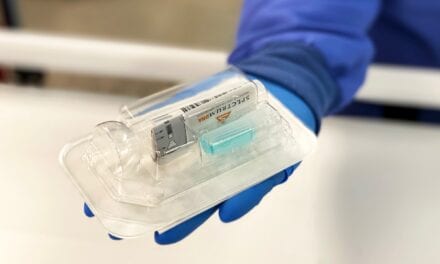
The new method avoids the costly and complex process of DNA sequencing by using an optical DNA chip. After extracting cell-free DNA from a blood sample, researchers label it with a light-emitting marker and bind it to a custom chip. An optical scanner then analyzes the resulting light patterns to identify the biological fingerprint of the tumor.
The study included 103 participants, consisting of 51 lung cancer patients and 52 healthy control subjects. Using a signature of 170 genomic regions, the researchers were able to distinguish between adenocarcinoma and squamous cell carcinoma, the two primary subtypes of lung cancer, based on distinct DNA signatures.
“Our goal is to make blood tests for cancer diagnosis more accessible, simpler, and less expensive without compromising accuracy,” says Yuval Ebenstein, PhD, professor at Tel Aviv University, in a release. “We have developed a new approach that does not require genetic sequencing but instead identifies the tumor’s chemical ‘fingerprint’ with light, using a technology that can be implemented in standard clinical laboratories.”
Clinical Application and Monitoring
Beyond initial diagnosis, the researchers evaluated the test’s potential for monitoring how patients respond to treatment. In preliminary findings, changes in the DNA chemical fingerprint corresponded with imaging results. Patients who responded to treatment showed a shift toward healthy profiles, while those who did not respond showed no significant change.
The technology is designed to complement computed tomography scans, which currently serve as the primary tool for early diagnosis but often produce suspicious findings that prove to be benign. By providing a molecular secondary check, the test could help reduce unnecessary biopsies and surgeries.
The test can be completed within two to three days at a cost of approximately $60 per sample. Researchers note that while the monitoring results are promising, large-scale studies are required to confirm the method’s effectiveness in tracking treatment response.
“This is a significant step toward developing a tool that can complement imaging tests and help physicians diagnose lung cancer and monitor treatment effectiveness,” says Ebenstein in a release.
Photo caption: Illustration of the new blood test, which uses a DNA chip to detect the tumor’s biological fingerprint.
Photo credit: Tel Aviv University