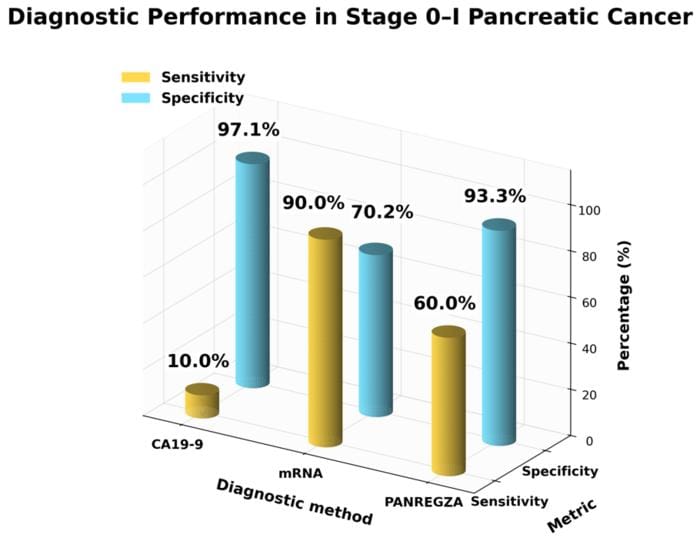
A Kanazawa University study found that a blood-based gene expression test detected 90% of early-stage pancreatic cancer cases, outperforming CA19-9, which identified only 10%.
Researchers at Kanazawa University report that blood-based gene expression tests may enable screening for early-stage pancreatic cancer, which could improve long-term survival rates.
The study, led by Taro Yamashita, dean of the graduate school of advanced preventive medical sciences and professor of gastroenterology at Kanazawa University, analyzed 10 patients with stage 0-I pancreatic cancer and 104 healthy individuals. Using a panel of 56 gene probes, the gene expression approach successfully detected 9 out of 10 cases of early-stage pancreatic cancer. In comparison, the tumor marker CA19-9 detected only 1 out of 10 cases.
“These findings indicate that gene expression analysis from peripheral whole blood is a highly effective method for detecting early-stage pancreatic cancer,” says Yamashita in a release.
The research team evaluated three diagnostic approaches: peripheral whole blood gene expression patterns (messenger RNA), the tumor marker CA19-9, and a combined test called Panregza. The combined test demonstrated 60% sensitivity and 93.3% specificity, adding to the growing body of research on multi-cancer blood tests designed to catch malignancies early.
Pancreatic cancer is among the most malignant cancers, with a five-year relative survival rate of 8.5% in Japan, according to National Cancer Center data. Curative treatment requires early detection and surgical resection, yet early-stage cases represent only 2% to 3% of all diagnosed cases. This diagnostic challenge is a primary factor contributing to poor prognosis.
The researchers previously identified that gene expression patterns in peripheral blood mononuclear cells (PBMCs) differ between patients with pancreatic cancer and healthy individuals. Most PBMCs are immune cells, and the study suggests that pancreatic cancer cells induce changes in gene expression by influencing these immune cells, even when the tumor burden is minimal.
The findings suggest that this diagnostic method enables detection that is not dependent on tumor volume, appearing even in patients with normal CA19-9 levels. At Kanazawa University Hospital, five-year survival rates are 100% for stage 0 and 74.4% for stage I pancreatic cancer, emphasizing the role of early diagnosis in patient prognosis. The Panregza diagnostic kit is currently marketed by Cubix Inc.
Photo caption: Diagnostic performance of peripheral whole blood gene expression patterns (mRNA), tumor marker CA19-9, and combined test (Panregza) for the diagnosis of stage 0–Ⅰ pancreatic cancer.
Photo credit: Kanazawa University