A highly sensitive blood test for KRAS mutations detected pancreatic cancer recurrence in more patients than standard methods, according to Northwestern Medicine research.
Northwestern Medicine scientists have demonstrated that a highly sensitive blood test can detect traces of pancreatic cancer missed by standard testing, potentially helping physicians identify patients whose disease is more likely to return even when scans appear reassuring.
The blood test focuses on KRAS, a genetic mutation that drives more than 90% of pancreatic cancers. These findings come as a new drug targeting KRAS is nearing review by the Food and Drug Administration (FDA).
“As we enter the era of KRAS-targeted therapies, having a screening tool that tracks the same mutation becomes increasingly important,” says Akhil Chawla, MD, clinical associate professor of surgery at Northwestern University Feinberg School of Medicine and complex surgical oncologist at Northwestern Medicine, in a release. “That combination could fundamentally change how we identify high-risk patients, monitor microscopic disease, and potentially intervene earlier before recurrence becomes clinically visible, ultimately getting more patients to cure.”
The study, published in Clinical Cancer Research, followed 106 patients with localized pancreatic cancer from diagnosis through chemotherapy and surgery. The research compared digital droplet PCR (ddPCR) to conventional next-generation sequencing (NGS), which is more commonly utilized in clinical settings.
At diagnosis, ddPCR detected signs of cancer in 65% of patients, compared to 17% for NGS. Following chemotherapy, ddPCR detected tumor DNA in 60% of patients while NGS detected it in 5%. After surgery, ddPCR detected signs of cancer in 56% of patients, compared to 9% for NGS.
“This suggests physicians may currently be missing residual disease in most patients using currently available testing approaches,” says Chawla, in a release.
According to the study, improved detection led to better prediction of survival outcomes. A group of high-risk patients whose cancer was missed by NGS but detected by ddPCR survived a median of 27 months after diagnosis. In comparison, patients who tested negative on both tests survived a median of 41 months.
Both NGS and ddPCR are liquid biopsies that search for traces of DNA shed by cancer cells into the bloodstream. While NGS searches for large numbers of cancer-associated genes simultaneously, ddPCR focuses on one set of genes at a time. In this study, the Northwestern team used ddPCR to focus specifically on KRAS mutations.
Chawla says the findings must be validated in larger multi-center studies before ddPCR can be used routinely in pancreatic cancer care.
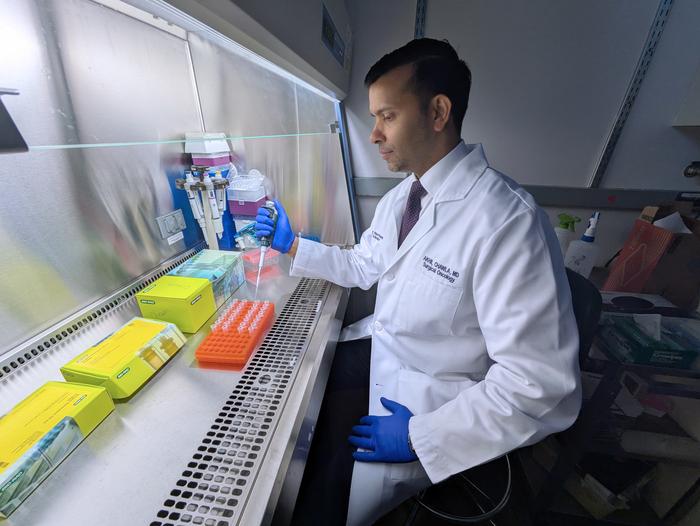
Photo caption: Study senior author Akhil Chawla, a complex surgical oncologist, works in his lab at Northwestern University Feinberg School of Medicine in Chicago.
Photo credit: Ben Schamisso / Northwestern University