Combining circulating microRNAs, exosomal microRNAs, and CA19-9, the investigational blood test also identifies high-grade dysplasia to guide clinical intervention.
An investigational liquid biopsy called Panxeon demonstrated 87% sensitivity in detecting stage 1 and stage 2 pancreatic cancer while maintaining low false-positive rates, according to a study published in Nature Medicine and announced in a City of Hope press release.
The multi-center study evaluated the blood test in nearly 1,800 patients across the US, Europe, and Asia to assess its clinical performance across diverse patient populations. According to the release, the test generated a 3% false-positive rate in low-risk groups and a 16% false-positive rate in high-risk groups. Additionally, Panxeon detected high-grade dysplasia—an advanced precancerous state frequently classified as stage 0 pancreatic cancer—in more than 64% of cases.
“Pancreatic cancer remains so deadly largely because we find it after the window for cure has begun to close,” says Ajay Goel, PhD, AGAF, chair of the department of molecular diagnostics and experimental therapeutics at City of Hope and senior author of the study, in a release. “For patients, these findings represent progress toward finding pancreatic cancer before symptoms appear and while more treatment options remain available.”
Multi-Analyte Architecture and AI Integration
Pancreatic cancer has a five-year survival rate of 14%, and approximately 90% of patients are diagnosed after the malignancy has already metastasized, according to City of Hope.
To address historical diagnostic limitations of single-marker assays, Panxeon measures three distinct biological markers from a single blood sample: circulating microRNAs, exosomal microRNAs, and CA19-9 protein. An artificial intelligence algorithm integrates all three analytical inputs into a single risk score, representing the first investigational assay to merge these specific biomarkers into a unified panel, the organization reports.
“Most biomarkers tell you one part of the story. Combining multiple biological signals gives us a clearer picture of what may be happening in the pancreas,” says Goel in a release.
Clinical Triage and High-Risk Monitoring
Rather than replacing standard diagnostic imaging modalities, Panxeon is designed to serve as a noninvasive triage tool to identify high-risk individuals who require further diagnostic workups, according to the researchers.
Target populations that could benefit from testing include individuals with inherited genetic risk factors, family histories of pancreatic cancer, pancreatic cysts, or chronic pancreatitis. Current surveillance protocols rely heavily on serial imaging and invasive procedures that can be costly and show variable utility in detecting the earliest neoplastic stages, the release notes.
“A stage shift is not just a statistic,” says Goel in a release. “The earlier we find pancreatic cancer, the greater the chance that meaningful intervention is still possible.”
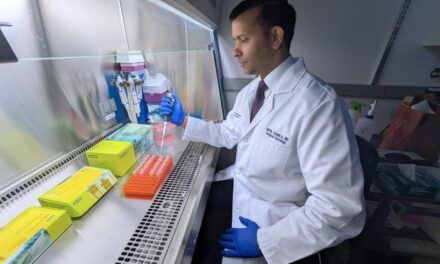
Photo caption: City of Hope researcher Ajay Goel, PhD, AGAF, led the development of a new, investigational blood test that could detect pancreatic cancer at its earliest stages, when the disease is more treatable and potentially curable. Called Panxeon, the liquid biopsy was highly sensitive in detecting stage 1 and 2 pancreatic cancer and had a low rate of false positives. The experimental test was also able to identify high-grade dysplasia, a precancerous condition of the pancreas, potentially enabling intervention before cancer develops.
Photo credit: City of Hope