The targeted sequencing approach detects low variant allele frequencies while maintaining simple workflow and cost efficiency, research shows.
A targeted next-generation sequencing method called Bridge Capture demonstrated superior sensitivity for detecting rare circulating tumor DNA variants compared to two leading commercial liquid biopsy assays, according to research published in The Journal of Molecular Diagnostics.
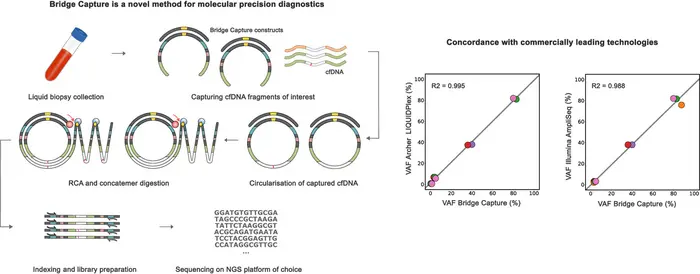
The study, conducted by researchers from Genomill Health Inc, the University of Turku, and TYKS Turku University Hospital in Finland, evaluated Bridge Capture using contrived colorectal cancer samples across a wide range of variant allele frequencies. The method showed strong concordance with Archer LIQUIDPlex and Illumina AmpliSeq CHPv2 while detecting the lowest variant allele frequency.
“Fast and sensitive tests usually cover only few variants that require prior information from a tissue biopsy. Other methods detect a wide range of variants, but require complex workflows, leading to long turnaround times, higher costs, and greater risk of human error,” says Manu Tamminen, PhD, CEO of Genomill Health Inc, in a release.
Efficient Sequencing Capacity Use
Bridge Capture maintained nearly identical results even when read depth was reduced 10-fold, demonstrating efficient use of sequencing capacity. The method targets cell-free DNA isolated from blood using a Bridge Capture probe construct, copies the target sequence into the probe construct, then circularizes it for linear amplification through rolling circle amplification.
“Because Bridge Capture uses sequencing capacity very efficiently, you can get low variant allele frequency calls without the need for deep sequencing. That directly translates into lower per-sample cost and opens high-sensitivity testing to labs with limited sequencing budgets,” says Anttoni Korkiakoski, senior bioinformatics specialist and PhD candidate and lead co-author, in a release.
The technology scales from compact hotspot panels to larger content panels without changing the core workflow, allowing one method to serve both focused clinical assays and broader panels.
Reproducibility Across Laboratory Settings
Interlaboratory testing showed consistent results, with reproducible outcomes between manual and automated workflows. The reproducibility data addresses a key concern for clinical laboratories considering new testing methods.
“What mattered to us wasn’t just performance in our own hands—it was whether another lab could pick it up just like that and get a corresponding answer. The reproducibility data confirm this is the case,” says Simona Adamusová, laboratory specialist and PhD candidate and lead co-author, in a release.
The simple, versatile workflow performs efficiently on low- to mid-throughput instruments, supporting cost-effective liquid biopsy testing in decentralized laboratory settings as cancer testing moves from large centralized laboratories to smaller sites.
“Bridge Capture is built for the reality of clinical sequencing today: labs need sensitivity for rare variants, but they also need workflows that are simple, fast, and cost-predictable. Our results show you don’t have to trade one for the other anymore,” says Juha-Pekka Pursiheimo, PhD, inventor of the technology at Genomill Health Inc, in a release.
The researchers indicate the method’s scalability to larger panels while maintaining workflow simplicity suggests potential for broader applications, including early cancer detection.
Photo caption: Research in The Journal of Molecular Diagnostics details the new method, Bridge Capture, which advances cancer diagnostics and monitoring via liquid biopsies. The cell-free DNA isolated from blood is targeted using the Bridge Capture probe construct. The target sequence is copied into the probe construct, which is then circularized. Circularized DNA is linearly amplified by rolling circle amplification that produces long concatemers, which are subsequently digested into linear monomers. The monomers are indexed and sequenced.
Photo credit: The Journal of Molecular Diagnostics / Adamusová et al