The system offers faster run times and reduced sample consumption for the analysis of viral vectors, protein aggregates, and advanced materials.
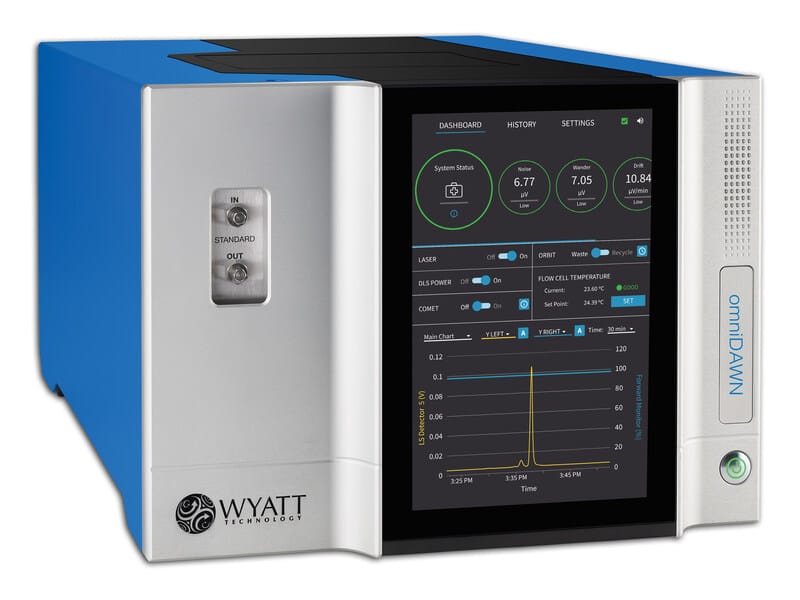
Waters Corp announced the launch of the omniDAWN Multi-Angle Light Scattering (MALS) photometer, an extended-range detector designed for ultra-high performance liquid chromatography (UHPLC) and ultra performance liquid chromatography (UPLC) workflows.
The photometer features 18 angles of detection and is the first extended-range MALS detector for UHPLC and UPLC, according to a company press release. The device provides absolute molar mass and size measurements without compromising resolution or throughput.
The system extends UPLC-compatible sizing 10-fold, ranging from approximately 50 to 500 nm in radius. This allows for the characterization of complex analytes such as protein aggregates, viral vectors, lipid nanoparticles (LNPs), and advanced materials. By providing absolute molar mass and size, the detector reduces reliance on column calibration standards and supports faster comparisons in biosimilarity studies, antibody-drug conjugate (ADC) characterization, and viral vector analytics.
“Advances in UHPLC and UPLC separations for complex biologics and newer modalities have outpaced detector technology, until now,” says Rob Carpio, senior vice president, Waters analytical sciences, Waters Corporation, in a release. “The omniDAWN MALS Photometer brings extended-range multi-angle light scattering to modern separations. This means our customers can move faster while maintaining the resolution, robustness, and depth of characterization needed to accelerate the discovery, development, and quality control of next-generation therapies.”
When paired with UHPLC or UPLC systems, the photometer supports chromatographic run times up to four times faster than conventional High Performance Liquid Chromatography (HPLC) workflows. The system also reduces sample consumption by 30% to 50% and solvent use by approximately 40%, according to the company. Its low-dispersion design is intended to preserve resolution and sensitivity while delivering data across complex samples. Sharper separations enhance the detection of low-level species, helping scientists distinguish monomer, aggregates, and fragments.
“Extending the capabilities of multi-angle light scattering to UHPLC and UPLC analysis will enable absolute molar mass measurements, paired with faster and more flexible separations,” says Stacey Louie, PhD, associate professor, department of civil and environmental engineering, University of Houston, in a release. “This represents a critical leap forward in MALS-based analyses, empowering us to better understand the structure of complex materials across drug delivery and environmental nanotechnology applications, ultimately supporting improved health outcomes.”
The photometer is powered by ASTRA software, which integrates MALS with ultraviolet and refractive index detection. The software enables the analysis of size, composition, and heterogeneity in a single run, with specific workflows for ADCs, LNPs, and viral vectors. The platform is 21 CFR Part 11 and EU Annex 11 compliant and is expected to be compatible with Waters Empower software later this year.
The detector is scheduled for global availability in summer 2026.
Photo caption: omniDAWN Multi-Angle Light Scattering
Photo credit: Waters Corp
Related Reading:
Waters and BD’s Biosciences & Diagnostic Solutions to Combine
TESTA Analytical’s Universal Detectors Support Chromatography Applications
The Transcend VTLX-1 UHPLC System Introduced by Thermo Fisher Scientific
New Nanoparticle System Triples CRISPR Gene-Editing Efficiency