The non-invasive test could reduce the need for surgical biopsies by more than 90% for patients with suspicious mouth lesions.
Researcher led by Queen Mary University of London have validated a non-invasive brush biopsy test that can detect oral cancer in one hour, according to a study published in the journal Biomarker Research.
The study, which included more than 1,000 samples from 545 patients, indicates the test could prevent more than 90% of unnecessary scalpel biopsies. These surgical procedures are often painful, can lead to infection, and may damage underlying tooth or bone structures in certain areas of the mouth.
Oral cancer is an increasing cause of early death globally, with more than 650,000 cases diagnosed annually. Risk factors include tobacco use, alcohol consumption, human papillomavirus (HPV) infection, and sun damage. Currently, more than half of mouth cancers are diagnosed at stage IV, the most advanced stage of the disease.
Improving the Diagnostic Pathway
Early diagnosis of oral squamous cell carcinoma (OSCC) is vital for survival, yet most oral potentially malignant disorders (OPMDs) are benign. The current diagnostic process often requires invasive scalpel biopsies even for low-risk lesions, which can discourage patients and clinicians from performing repeated testing.
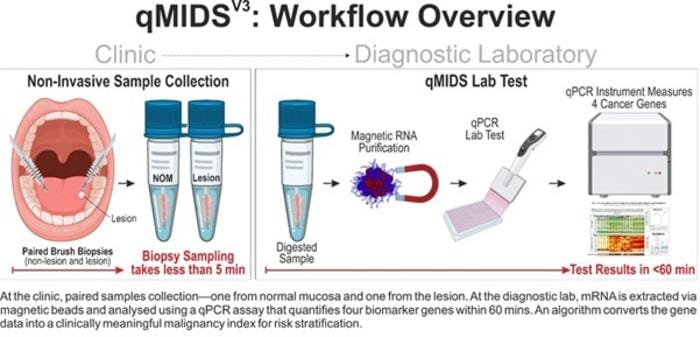
The new study evaluated whether a multigene test, qMIDS-V3, could accurately detect OSCC using a brush swab rather than a tissue sample. The results showed that the brush test performance is comparable to previous versions that required a 1 millimeter tissue microbiopsy.
“Oral cancer survival is directly linked to how early it is found, yet our current diagnostic pathway is blunt most patients with a suspicious lesion end up having an invasive biopsy even when the overwhelming likelihood is that it is benign,” says Muy-Teck Teh, PhD, professor of molecular oral oncology at Queen Mary University of London, in a release. “This test changes that. It gives clinicians a rapid, accurate, and non-invasive way to triage patients, and crucially, it can be repeated.”
Clinical and Financial Impact
In the UK, audits have shown a 450% increase in urgent referrals for suspected oral cancer over 10 years, while the cancer detection rate dropped by 50%. Data indicates that between 92.5% and 99.5% of referred patients were cancer-free.
Implementing the qMIDS-V3 test as a triage tool could reduce unnecessary referrals for more than 90% of cancer-free patients. This shift would lessen the clinical and financial burden of managing OPMDs and OSCC on health systems.
“We were genuinely astonished by the fact that the brush swab test performance is comparable to a microbiopsy,” says Teh in a release. “It suggests that the biological signal captured by these four genes is sufficiently strong and consistent that it can be detected even from the superficial exfoliated cells collected by a brush biopsy.”
Monitoring High-Risk Patients
The test also provides a tool for long-term surveillance of patients with persistent OPMDs. Because the brush swab is non-invasive and repeatable, clinicians can monitor these high-risk groups regularly and systematically to identify malignant transformations at an earlier stage, addressing an ongoing clinical need for reliable surveillance in head and neck cancers.
The research team included scientists from the Queen Mary University of London Centre for Oral Immunobiology and Regenerative Medicine, King George’s Medical University, Modern Dental College and Research Centre, and the All India Institute of Medical Sciences.
Queen Mary University of London is currently seeking a commercial partner to develop the test for clinical use. Researchers suggest the test could be available within two years with an appropriate partnership.
Photo caption: Oral cancer brush test diagram
Photo credit: Teh, MT, Patil, R, Tekade, SA et al