The new system combines optical microscopy with infrared spectroscopy to accelerate molecular analysis and chemical mapping of microscopic samples.
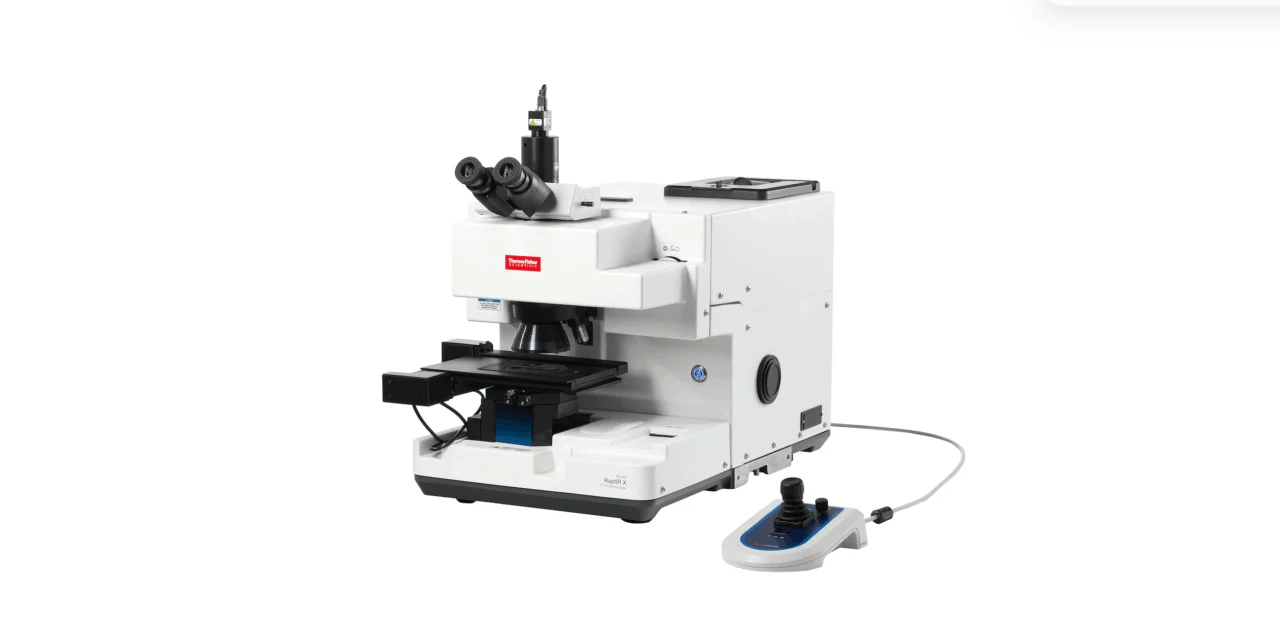
Thermo Fisher Scientific has launched the Thermo Scientific Nicolet RaptIR X FTIR Microscope, an analytical instrument designed to simplify and accelerate chemical analysis of microscopic samples.
The instrument combines high-definition optical microscopy with Fourier transform infrared spectroscopy (FTIR) microspectroscopy to help laboratories pinpoint microscopic features and determine their molecular composition. Applications for the system span pharmaceutical formulation analysis, materials science, microplastics identification, failure analysis, forensic investigations, and geological research.
“The RaptIR X microscope brings the speed, precision and flexibility laboratories need to investigate increasingly complex samples, while making advanced FTIR microscopy easier to use than ever before,” says Ganesh Prasad, general manager, vibrational spectroscopy products at Thermo Fisher Scientific, in a release. “It’s a platform that reflects our commitment to innovation — giving laboratories the confidence to move from a microscopic observation to a molecular answer, quickly and reliably.”
Workflow and Imaging Capabilities
The RaptIR X microscope is operated using Thermo Scientific OMNIC Paradigm Software, which provides guided workflows for sample acquisition and analysis to assist both experienced spectroscopists and new operators.
For high-speed chemical mapping across large sample areas, the system can collect up to 10 spectra per second at a 5-micron spatial resolution. Optical capabilities include a 1-micron visible resolution alongside a 5-micron infrared resolution, allowing operators to visualize fine sample details and determine their chemical composition.
Sample Handling and Modular Integration
To accommodate challenging or oversized specimens, the microscope features a heavy-duty stage built to support samples up to 40 mm thick and weighing up to 5 kg. Automated detector switching and a fixed detector position are included to minimize manual adjustments and maintain measurement consistency across varied ranges.
The modular platform can function as a standalone system or integrate with Nicolet Apex or Nicolet iS50 FTIR spectrometers. Laboratories can also configure the system with optional capabilities, including micro-ATR, polarized visible and infrared analysis, fluorescence visualization, near-infrared microscopy, grazing angle optics, and additional detectors.
Photo caption: Nicolet RaptIR X FTIR Microscope
Photo credit: Thermo Fisher Scientific