New research suggests DNA profiling can monitor treatment response and identify patients most likely to benefit from bone-targeted therapy.
A noninvasive DNA blood test can identify patients with advanced prostate cancer who are most likely to benefit from radiopharmaceutical therapy and monitor their progress during treatment, according to research published in the July issue of The Journal of Nuclear Medicine.
The study focused on patients with metastatic castration-resistant prostate cancer (mCRPC) receiving 223Ra dichloride, a bone-targeted radiopharmaceutical therapy shown to improve overall survival and quality of life. However, because clinical outcomes vary among patients, there has been a lack of reliable biomarkers to predict or monitor treatment response.
“Circulating tumor DNA (ctDNA) testing—a simple blood test—has emerged as a promising approach to advance precision oncology,” says Masaki Shiota, MD PhD, associate professor in the department of urology in the graduate school of medical sciences at Kyushu University, in a release. “Compared to tumor biopsies, ctDNA can be collected less invasively and repeatedly, providing a real-time genomic snapshot of the tumor and its heterogeneity that could provide valuable information in the context of 223Ra therapy.”
Analyzing Genomic Profiles
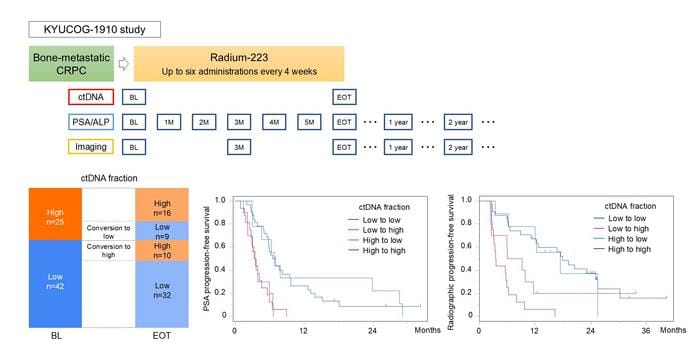
The research team investigated the genomic landscape and clinical utility of ctDNA profiling in 93 patients with mCRPC. These patients underwent targeted ctDNA testing using an 88-gene panel before and after receiving 223Ra therapy. Researchers analyzed associations between the DNA profiles and clinical outcomes, including biomarker response, radiographic progression-free survival, and overall survival.
The analysis found that patients with a higher amount of tumor DNA in the blood or specific genetic changes, such as TP53, PTEN, and cell cycle pathway alterations, had worse outcomes when detected before treatment. The study also demonstrated that changes in tumor DNA during treatment reflected the disease trajectory and the patient’s response to the therapy.
Optimizing Personalized Care
The findings suggest that incorporating DNA profiling into clinical practice could refine patient selection and enable the early detection of treatment resistance.
“While 223Ra is an important treatment for prostate cancer that has spread to the bones, not all patients benefit equally,” says Shiota, in a release. “Our findings suggest that a blood-based genomic test may help identify patients who are more likely or less likely to benefit from the therapy. This could help doctors choose treatment more carefully and monitor patients more closely, with the goal of providing more personalized care.”
The study was conducted by researchers from several institutions, including Kyoto University, Kagoshima University, and Kyushu University.
Photo caption: Changes in circulating tumor DNA during 223Ra treatment reflect disease course in patients with bone-metastatic castration-resistant prostate cancer.
Photo credit: Image created by Masaki Shiota et al, Kyushu University, Fukuoka, Japan.