
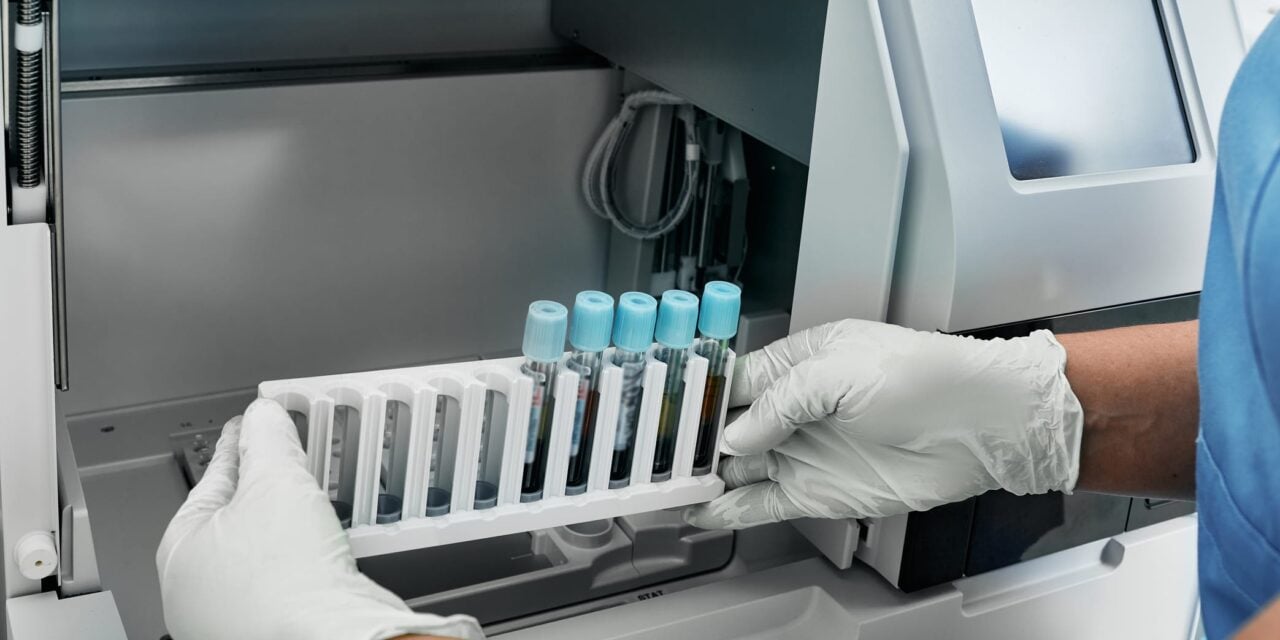
A closer look at how APTT reagents, activators, and detection systems affect one of the lab’s most widely used clotting assays.
Sponsored by Sysmex
Few coagulation assays are as routinely ordered—or as widely misunderstood—as the activated partial thromboplastin time (APTT). The APTT is the second most frequently requested coagulation test, used both to monitor unfractionated heparin therapy and to screen for bleeding disorders associated with the intrinsic pathway.
Despite its widespread use, the assay’s performance can vary considerably from lab to lab because of differences in reagent composition, activator chemistry, and instrument detection methods. These differences can affect the assay’s responsiveness to heparin, clotting factor deficiencies, and lupus anticoagulants.
Sysmex notes that “it is absolutely essential that each laboratory has a quality control mechanism in place and establishes its own reference range for the interpretation of APTT results generated locally.” The company attributes this need to differences in the composition and reactivity of APTT reagents and the detection systems used by automated analyzers.
What ‘Partial’ Really Means
The assay’s name reflects its chemistry. The word “partial” refers to the fact that the reagent used in the APTT lacks the tissue factor that is a core component of the thromboplastin reagent used in the prothrombin time. It contains only the phospholipid component.
The test dates back more than seven decades. The partial thromboplastin time (PTT) was described by Langdell, Wagner, and Brinkhous in 1953 as a test for hemophilia.1 In 1961, Proctor and Rapaport published a modified version that incorporated kaolin to activate the contact phase of coagulation, producing shorter and more reproducible clotting times.2 That modification became known as the activated partial thromboplastin time (APTT). Although PTT and APTT are still commonly used interchangeably, APTT is the more technically accurate term for the activated test used today.
Inside the Reagent
APTT reagents have two principal components: an activator and a source of phospholipid. The activator can be particulate in nature, such as kaolin, celite, or silica, or soluble, such as ellagic acid.
The activator supplies the negatively charged surface needed to trigger the contact factors—high molecular weight kininogen (HMWK), prekallikrein, and factor XII. During this contact activation phase, FXII is activated to FXIIa with the help of HMWK and kallikrein and, in turn, converts FXI to FXIa.
Phospholipids provide the surface needed for the assembly of the tenase complex (FIXa-FVIIIa), which converts FX to FXa, and the prothrombinase complex (FXa-FVa), which converts prothrombin to thrombin. Phospholipid source and concentration vary among commercial reagents. The phospholipid may be of animal or plant origin or synthetically manufactured to produce a pure form.
Why Variability Matters
Differences in the concentration and composition of APTT reagents can result in considerable variation in their responsiveness to heparin, clotting factor deficiencies, and lupus anticoagulants. The type of detection system used by automated analyzers, such as mechanical versus optical detection, can also contribute to variability.
For labs, reagent selection therefore needs to account for how the APTT will primarily be used. Some reagents, for example, are designed to be more or less sensitive to lupus anticoagulants. Reagent selection should account for the primary indication for APTT testing.
How Sysmex Supports APTT Testing
Sysmex offers two APTT reagents optimized for different clinical indications.
Actin FSL is the reagent of choice for routine APTT testing where lupus anticoagulant (LA) sensitivity is clinically relevant. Its high sensitivity to phospholipid-dependent inhibitors makes it appropriate for LA screening, and when paired with factor-deficient plasmas, it supports reflex testing for intrinsic pathway factor deficiencies (Factors VIII, IX, XI, and XII).
Actin FS is indicated when LA insensitivity is required — for example, monitoring unfractionated heparin therapy in patients with a known or suspected LA, where an LA-sensitive reagent may yield spuriously prolonged results unrelated to anticoagulant effect.
Both reagents are liquid, ready-to-use with no reconstitution or standing time required, and offer extended onboard stability. A 12-month lot sequester and lot rollover assistance are available to support consistency across testing periods.
On the CA-Series, CS-Series, and CN-Series automated coagulation analyzers, both reagents integrate with Sysmex’s preanalytical sample integrity checks (CS- and CN-Series) to reduce first-pass errors before testing begins — a meaningful operational advantage in high-volume or stat-testing environments.
Takeaways for the Lab
Because APTT reagent-instrument combinations can behave differently, laboratories need to establish and validate their own reference ranges, monitor reagent lot-to-lot performance, and select reagents based on how the assay will be used, whether for heparin monitoring, factor deficiency screening, or lupus anticoagulant detection.
Understanding how the assay works, from contact activation through thrombin generation, can also help laboratorians understand the factors that influence APTT results and interpret them appropriately.
References
- Langdell RD, Wagner RH, Brinkhous KM. Effect of antihemophilic factor on one-stage clotting tests; a presumptive test for hemophilia and a simple one-stage antihemophilic factor assy procedure. J Lab Clin Med. 1953;41(4):637-47.
- Proctor RR, Rapaport SI. The partial thromboplastin time with kaolin. A simple screening test for first stage plasma clotting factor deficiencies. Am J Clin Pathol. 1961;36:212-19.
Sponsored by

Medqor is committed to protecting and respecting your privacy. We may contact you about our products and services or share information with sponsorship partners, as well as other content that may be of interest to you. By submitting your information, you consent to us contacting you for this purpose in accordance with our privacy policy.
For further information, please check out our privacy policy here.
ID 457713920 | Blood © Daria Liubenko | Dreamstime.com