
Research suggests the long-read sequencing approach can replace 15 separate tests and increase diagnostic yield for patients.
A new DNA test provides a more detailed view of genetic material than current standard diagnostics, leading to more frequent diagnoses for rare genetic disorders. The test can replace 15 other diagnostic tests, potentially increasing efficiency and speed in the clinical laboratory.
Researchers from Radboud University Medical Center and Maastricht University Medical Center+ recommend that this test be adopted as the primary choice for rare genetic disorders, according to a study published in the New England Journal of Medicine.
The study compared current standard diagnostics, which often involve multiple tests to reach a diagnosis, with the new DNA test in 1,000 patients. “We showed that the new test yields three percent more diagnoses. It can also replace fifteen other tests. We recommend using this test worldwide as the first choice,” says Lisenka Vissers, professor of translational genomics, in a release.
Long-Read Genome Sequencing Technology
The test is based on long-read genome sequencing. When searching for genetic abnormalities, clinicians examine a patient’s complete DNA. While current standard diagnostics typically analyze DNA in fragments of approximately 300 building blocks, the new test reads segments of up to 20,000 building blocks. This larger scale makes assembling the DNA sequence easier and results in a more complete picture of the genome.
In addition to sequencing building blocks, the new test identifies modifications on the outside of the DNA. These modifications can switch genes on or off and are sometimes the underlying cause of a rare disorder.
“With current diagnostics, this requires additional specialized tests, but with long reads we capture these modifications as a bonus—two in one,” says Christian Gilissen, professor of genome bioinformatics, in a release.
Increasing Diagnostic Yield
The number of diagnoses is expected to continue rising as the technology allows for a more detailed view of DNA and the detection of complex, hard-to-find abnormalities. Researchers can then link these findings to specific conditions to grow the collective knowledge base.
“Thanks to long reads, we obtain an even more complete view of DNA and can detect complex and hard-to-find abnormalities. We then link these to specific conditions. In this way, our knowledge grows and we can make more diagnoses,” says Alexander Hoischen, professor of genomic technologies, in a release.
The technology was recently utilized at the Undiagnosed Hackathon in Nijmegen, where nearly 150 specialists from Dutch university medical centers gathered to find diagnoses for 33 families. The test mapped the DNA of all families in detail, which, combined with specialist expertise, resulted in five new diagnoses.
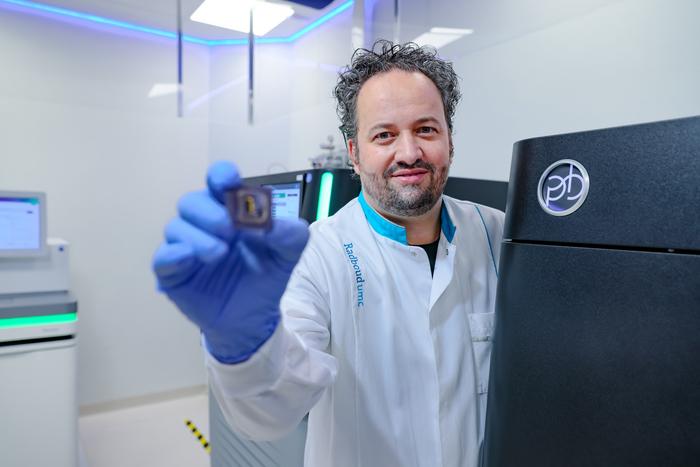
Photo caption: Professor Alexander Hoischen using long-read genome sequencing
Photo credit: Radboudumc


