
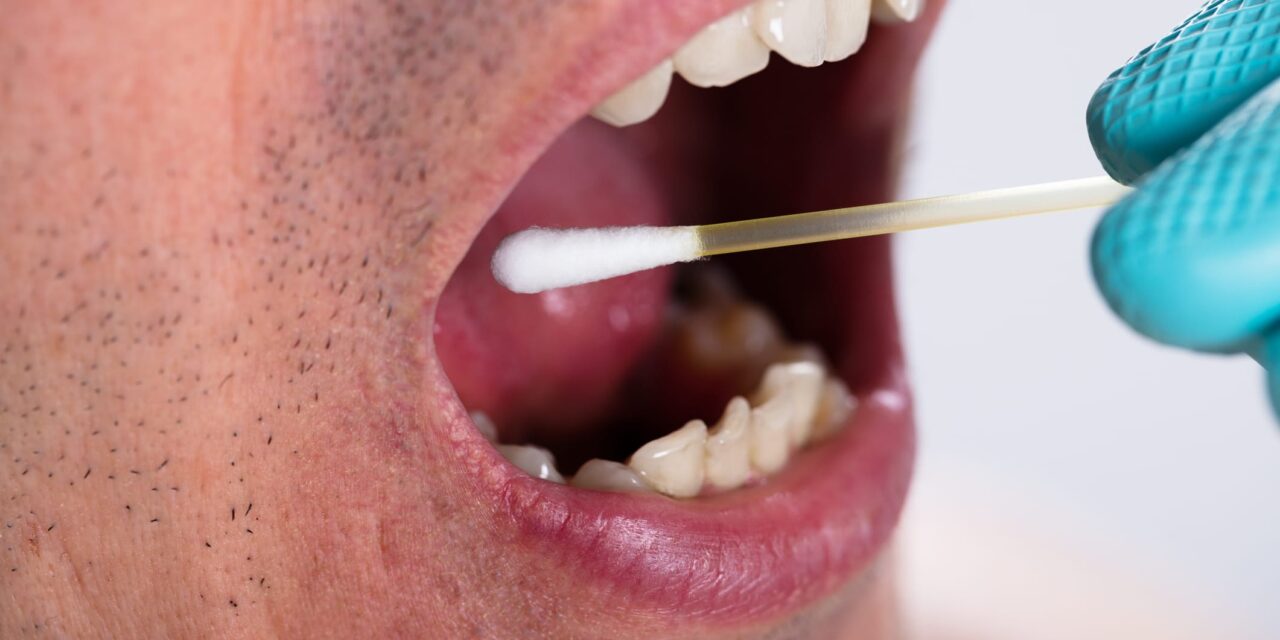
The noninvasive test uses an oral swab to measure peptide ratios, aiming to reduce unnecessary biopsies and improve diagnostic access.
A research team led by Case Western Reserve University is developing a noninvasive oral cancer test designed to provide results within minutes at the chairside to help clinicians determine if a suspicious lesion requires a biopsy.
The project is supported by a five-year, $2.93 million grant from the National Cancer Institute, which is part of the National Institutes of Health (NIH). The award is structured as an academic-industrial partnership, teaming university researchers with Hemex Health to advance the technology from the laboratory to a commercial point-of-care product.
The test, known as the BDI fluorescence immunoassay, measures the ratio of two naturally occurring peptides: human beta-defensin-3 and human beta-defensin-2. This ratio, which the research team calls the beta-defensin index, corresponds with the presence of oral squamous cell carcinoma.
“Our goal is to take a sophisticated laboratory measurement and engineer it into a simple, affordable device that works reliably at the chairside,” says Aaron Weinberg, DMD, PhD, professor and chair of the department of biological sciences at the School of Dental Medicine, in a release. “Manufacturing and validating that device to a commercial standard is exactly the kind of translational engineering challenge our collaboration was built to solve.”
Weinberg’s laboratory was among the first to identify that human beta-defensin-3 becomes overexpressed while human beta-defensin-2 declines during the early stages of oral cancer. By measuring these levels through a simple oral swab, the test provides a noninvasive alternative to immediate surgical intervention.
In clinical settings, approximately 90% of suspicious lesions that are biopsied turn out to be benign, according to Weinberg. While these results are reassuring, the biopsies add unnecessary costs, discomfort, and patient anxiety. The rapid test could help clinicians identify which patients truly require a biopsy and serve as a screening tool in regions with limited pathology services.
The American Cancer Society estimates there will be approximately 60,480 new cases of oral and throat cancers and 13,150 deaths in the US this year. Oral squamous cell carcinoma is especially prevalent in low- and middle-income countries where diagnostic services are often delayed or inaccurate.
The development team includes Umut Gurkan, professor of engineering at the Case School of Engineering and director of the Case Biomanufacturing and Microfabrication Laboratory, and Peter Galen, chief innovation officer and co-founder of Hemex Health. Gurkan’s group is contributing point-of-care device design, microfabrication, and analytical validation. Hemex Health will lead the efforts toward regulatory clearance and manufacturing.
The research team plans to pursue commercialization through regulatory agencies in both the US and India. The project previously received pilot funding from the Case-Coulter Translational Research Partnership, the NIH Point-of-Care Technologies Research Network, and the Ohio Third Frontier.
ID 124742376 © Andrey Popov | Dreamstime.com