The company is introducing blood-based assays for tau biomarkers and a platform to automate laboratory workflows.
Spear Bio announced it will unveil new immunoassays and a fully automated instrument platform at the Alzheimer’s Association International Conference 2026 in London, UK.
The launches include a singleplex immunoassay for eMTBR-Tau and an assay for pTau 217 that measures the biomarker across both venous and capillary blood. These tools are designed to help researchers investigate amyloid-associated tau phosphorylation and tau tangle pathology using ultra-low sample volumes, according to the company.
Assay Technology and Performance
The new assays are built on Successive Proximity Extension Amplification Reaction technology. This method combines attomolar sensitivity with a wash-free workflow and requires 1 µL of diluted plasma. The technology allows scientists to preserve biospecimens while generating biomarker data for Alzheimer’s disease, neurodegeneration, and preclinical research, according to Spear Bio.
The eMTBR-Tau immunoassay is designed as a standalone test that provides a quantitative approach to measuring biology associated with tau tangles. The pTau 217 assay complements this by enabling consistent measurement in different blood types to support the study of tau phosphorylation.
Automated Workflow Integration
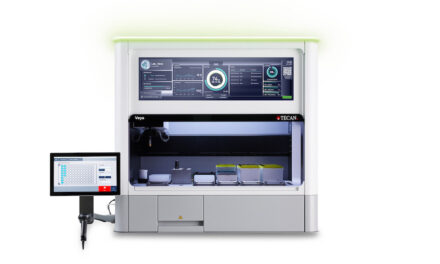
The new instrument platform is designed to automate the company’s workflows from the initial sample to a quantitative polymerase chain reaction-ready plate. By reducing manual handling, the system supports more consistent execution of biomarker assays and is intended to help laboratories scale and integrate the technology into research and clinical development.
“Our focus is on building innovations that help researchers answer questions that were previously difficult to address with conventional protein biomarker tools,” says Feng Xuan, founder and CEO of Spear Bio, in a release. “As the field advances from biomarker discovery toward broader validation, vigorously verified assays become essential to generating reliable, reproducible insights.”
According to Xuan, the platform provides researchers with a way to measure complex Alzheimer’s disease biology and supports the next stage of neurodegenerative disease research.
In addition to the product launches, the company plans to present data regarding synucleinopathy and TDP-43 proteinopathy at the conference. Presentations will include discussions on using the assays for amyloid pathology discrimination and studies in mouse models.
ID 405209537 | Pathology © Skypixel | Dreamstime.com