Researchers reported that the test reduced unnecessary biopsies by up to 64% without compromising detection of aggressive prostate cancers.
A new urine test performed better than prostate-specific antigen testing and magnetic resonance imaging (MRI) for monitoring low-risk prostate cancers on active surveillance, according to a study published in The Journal of Urology.
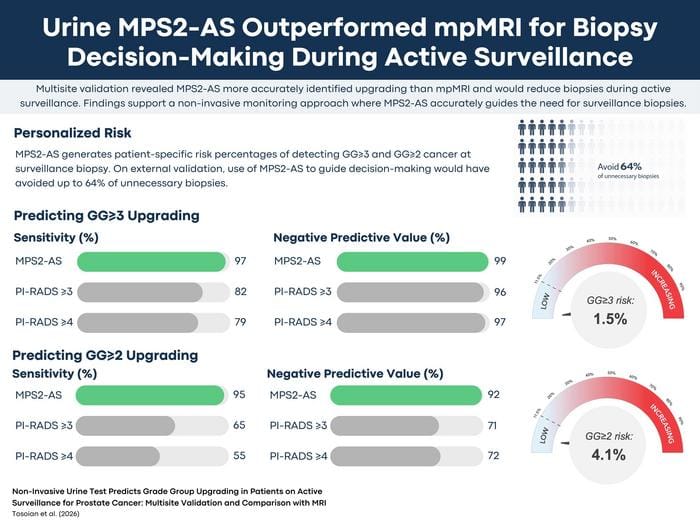
The test, called MyProstateScore 2.0 – Active Surveillance (MPS2-AS), could have avoided up to 64% of unnecessary biopsies while maintaining timely detection of higher-grade cancers that require treatment. The study evaluated the test in more than 300 patients on active surveillance for Grade Group (GG) 1 prostate cancer.
“For patients undergoing monitoring of low-grade prostate cancer, these findings suggest that use of the urine test can reduce the need for invasive biopsies without compromising prompt detection of higher-grade cancers that require treatment,” says Jeffrey Tosoian, MD, MPH, assistant professor in the Department of Urology at Vanderbilt Health, in a release.
Active surveillance is widely used in men with low-risk prostate cancer to avoid unnecessary treatment of cancers unlikely to cause harm. Because some patients will later be found to upgrade to higher-risk cancers, surveillance requires careful monitoring. Due to the limitations of existing tools, the current approach requires repeat prostate biopsies, usually every two to three years. The urine test offers a noninvasive option to determine which patients require a biopsy and which can avoid the procedure.
In patients previously diagnosed with low-grade cancers pursuing active surveillance, MPS2-AS correctly predicted the presence of high-grade (GG 3 or higher) cancer in 97% of cases. The test demonstrated a 99% negative predictive value for GG 3 or higher upgrading, meaning that patients with a negative test had only a 1% chance of having high-grade cancer detected on biopsy.
“For the vast majority of patients, that is low enough to confidently forgo the biopsy altogether,” says Tosoian in a release.
Other noninvasive tests have been studied in active surveillance, but the research team says none have had sufficient accuracy to rule out the need for repeat biopsies. Next steps for the collaborative team include studying the use of this testing approach to improve other aspects of prostate cancer care, such as detecting recurrence after treatment.
The study was supported by the National Institutes of Health.
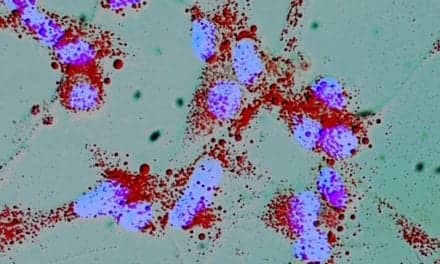
Photo caption: Prostate cancer grading uses the Gleason score (6-10) and Grade Group (1-5) systems to estimate cancer aggressiveness based on how the cells look under a microscope. Higher numbers indicate faster-growing, more aggressive cancer.
Photo credit: Tosoian et al (2026)